

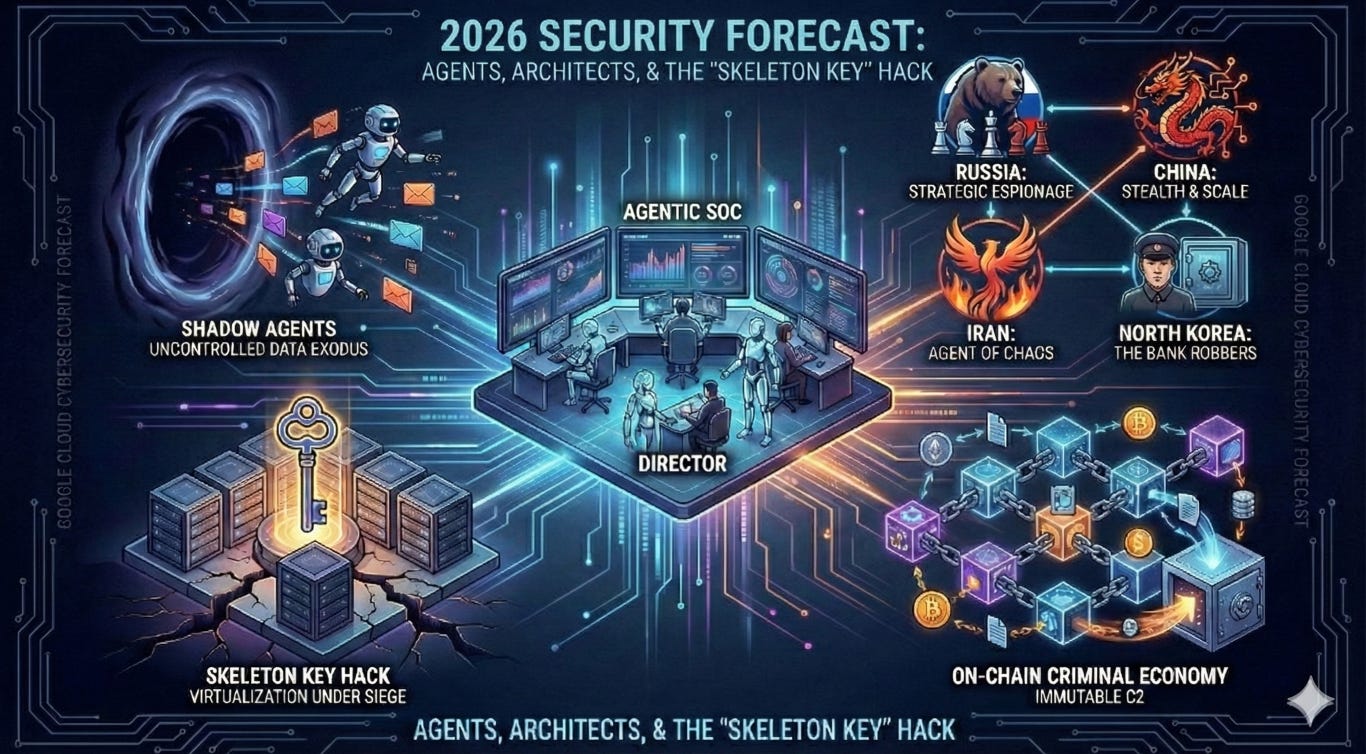
If you’ve been waiting for the moment when Artificial Intelligence stops being a buzzword and starts being the fundamental operating system of cybersecurity, Google Cloud says that moment is 2026.
I just finished analyzing the Google Cloud Cybersecurity Forecast 2026, a report that explicitly avoids crystal ball gazing in favor of data-driven extrapolation. The findings paint a picture of a world that is faster, more automated, and significantly more complex than the one we defend today.
We are moving away from the era of Alert Fatigue and entering the era of Agentic Warfare. Here is what that means for defenders, leaders, and the digital ecosystem.
1. Rise of the Agentic SOC
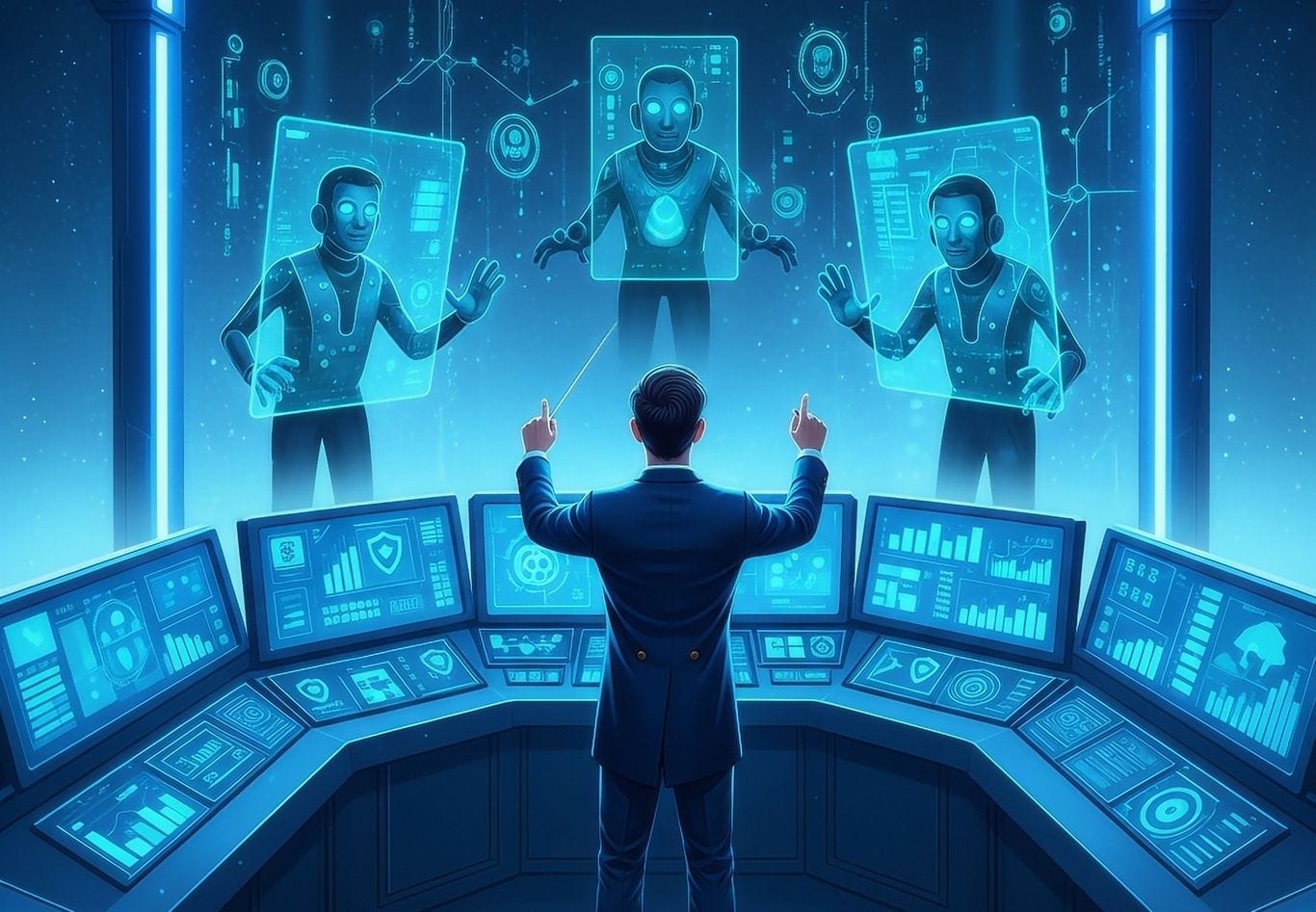
For years, the Security Operations Center (SOC) has been defined by burnout. Analysts drown in logs, desperately trying to correlate data points before the breach spreads.
In 2026, the analyst’s role fundamentally shifts from investigator to director.
The report introduces the concept of the Agentic SOC. In this model, AI agents handle the heavy lifting of data correlation and hypothesis testing. Imagine an analyst asking their AI, "Hunt for TTPs related to UNC5221 across our environment," and the AI returning not just a list of logs, but a fully drafted threat report with attribution and mitigation strategies.
This isn't about replacing humans; it's about "supercharging" them. The AI creates the case summary; the human makes the strategic decision to contain the threat.
Dark Side: Shadow Agents
However, this agentic power comes with a massive blind spot. Just as we spent the last decade fighting Shadow IT, 2026 will be the year of Shadow Agents, autonomous AI workflows deployed by employees without IT approval.
The Industry Reality: The shift is already here. Recent data reveals that 98% of organizations now have employees using unsanctioned AI apps. Even more concerning is the volume of data: GenAI traffic surged more than 890% in 2024, creating a massive, unmonitored data exodus that traditional tools are missing.
The Takeaway: We need a new discipline of "Agentic Identity Management." We must treat AI agents as distinct digital actors with their own identities, access logs, and "least privilege" constraints.
2. Adversary’s Toolkit: Vishing and Deepfakes

While defenders are building Agentic SOCs, attackers are weaponizing AI to hack the most vulnerable OS of all: the human being.
The forecast predicts that groups like ShinyHunters (UNC6240) will accelerate the use of AI-enabled social engineering, specifically vishing (voice phishing) that clones executive voices with hyper-realistic precision.
The Industry Reality: The barrier to entry has collapsed, and the costs are skyrocketing. Deepfake-related fraud losses hit $1.1 billion in 2025—tripling the losses from 2024. This isn't a theoretical risk; it is an active financial hemorrhage, with 83% of these losses originating from scams on social platforms.
3. Skeleton Key Hack: Virtualization Under Siege

Perhaps the most technically alarming trend is the pivot toward virtualization infrastructure. Attackers have realized that if they can’t beat the EDR agent inside the OS, they can just go underneath it.
Adversaries are targeting the hypervisor, the foundational layer hosting your virtual machines. This is a Skeleton Key scenario. A successful breach here allows attackers to encrypt hundreds of servers simultaneously, rendering an enterprise inoperable in hours.
The Industry Reality: Attackers are moving fast to exploit this blind spot. In 2024, 45% of retail organizations were hit by ransomware, with a marked shift toward infrastructure-aware attacks targeting layers like VMware ESXi. Active exploitation of vulnerabilities in these layers is allowing groups to bypass guest-level security entirely.
4. On-Chain Criminal Economy
Cybercrime is also getting a Web3 upgrade. The report forecasts that ransomware and extortion groups will move core components of their infrastructure, like Command and Control (C2), onto public blockchains. This makes their operations immutable and nearly impossible to take down.
The Industry Reality: This shift is being funded by historic theft levels. In the first half of 2025 alone, criminals stole nearly $2.17 billion in crypto-related crimes, putting the year on track to be the worst ever for digital asset theft.
5. Geopolitical Chessboard
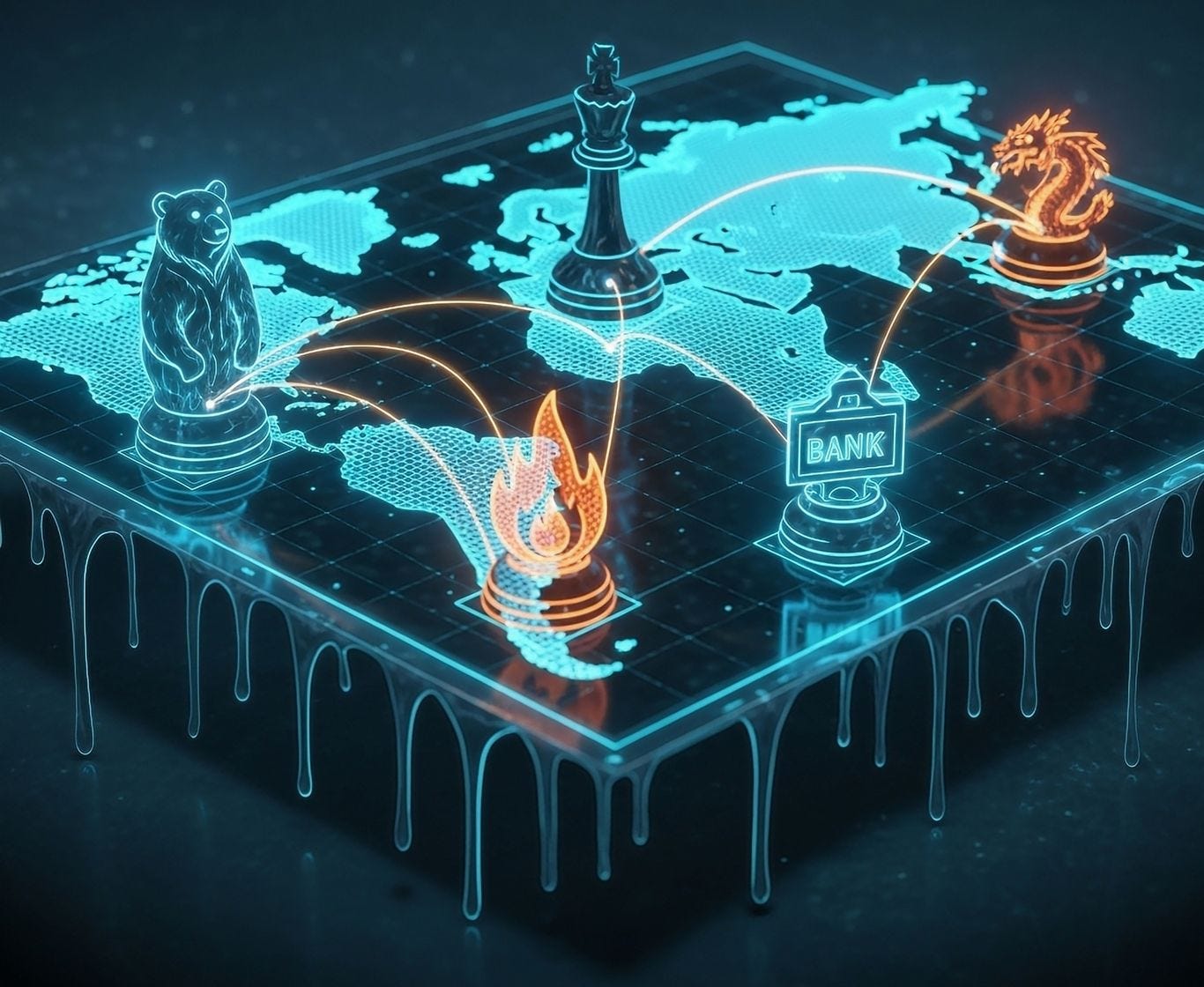
Finally, the report breaks down the strategic shifts of the "Big Four" nation-state actors:
Russia
Shifting back to long-term strategic espionage against NATO and the West.
The Industry Reality: The strategic pivot is evident in the numbers. Russian cyberattacks against NATO member states surged by 25% over the last year. Since Autumn 2025, there has been a sharp escalation in "hybrid" incidents, ranging from sabotage to espionage, targeted at European defense contractors and logistics.
China
Focusing on stealth and scale, targeting edge devices to pre-position access.
The Industry Reality: Mandiant and Google Cloud have observed suspected China-nexus actors actively exploiting zero-day vulnerabilities in edge devices (like VPNs) to deploy malware families like TRAILBLAZE, specifically targeting government and defense sectors.
Iran
The agent of chaos, blurring the lines between espionage and destructive wiper attacks.
The Industry Reality: The line between state actor and hacktivist has nearly vanished. Following the escalation of conflict in June 2025, Iranian state-sponsored attacks against Israeli critical infrastructure (power grids, hospitals) surged by 700%. Groups like "Void Manticore" are deploying wiper malware disguised as ransomware to target NGOs and think tanks, prioritizing destruction over financial gain.
North Korea
The bank robbers, using crypto theft to fund the regime.
The Industry Reality: North Korea's pivot to crypto theft is a primary GDP driver. In 2025, DPRK hackers stole at least $2.02 billion in cryptocurrency, a 51% increase from the previous year.
Final Thoughts: 2026 The Year of Governance
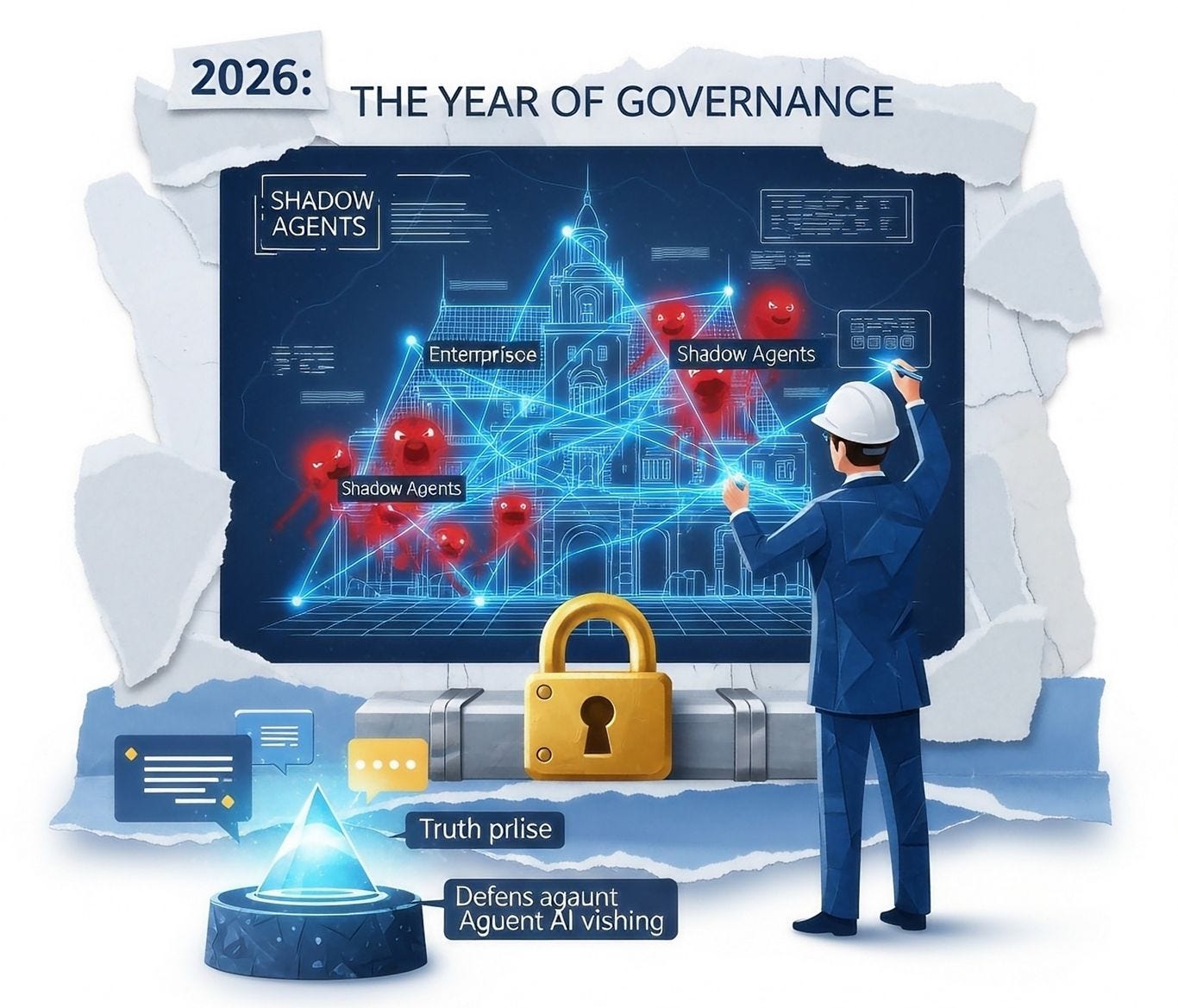
If 2024 and 2025 were about experimenting with AI, 2026 will be about governing it.
The organizations that survive this shift won't just be the ones with the best firewalls.
They will be the ones that have successfully mapped their Shadow Agents, secured their hypervisors, and trained their people to doubt their own ears when the CEO calls asking for a password!
Read the full Google Cloud Cybersecurity Forecast 2026 report HERE
Thanks for reading! If you found this summary helpful, please subscribe and share it with your security team.
Happy computing
Michael Plis
References
Read the full Google Cloud Cybersecurity Forecast 2026 report here: https://www.linkedin.com/posts/michaelplis_google-cybersecurity-forecast-2026-activity-7426836752100708352-GGyD
1. AI Gone Wild: Why Shadow AI Is Your IT Team's Worst Nightmare: https://cloudsecurityalliance.org/blog/2025/03/04/ai-gone-wild-why-shadow-ai-is-your-it-team-s-worst-nightmare
2. How to tackle the rising threat of shadow AI: https://australiancybersecuritymagazine.com.au/how-to-tackle-the-rising-threat-of-shadow-ai/
3. Deepfake fraud caused financial losses nearing $900 million: https://surfshark.com/research/chart/deepfake-fraud-losses
4. Detecting dangerous AI is essential in the deepfake era: https://www.weforum.org/stories/2025/07/why-detecting-dangerous-ai-is-key-to-keeping-trust-alive/
5. Ransomware on ESXi: The Mechanization of Virtualized Attacks: https://thehackernews.com/2025/01/ransomware-on-esxi-mechanization-of.html
6. Ransomware operators actively exploiting VMWare ESXi hypervisor vulnerability: https://www.imda.gov.sg/-/media/imda/files/regulations-and-licensing/regulations/advisories/infocomm-media-cyber-security/ransomware-operators-actively-exploiting-vmware-esxi-hypervisor-vulnerability.pdf
7. 2025 Crypto Theft Reaches $3.4 Billion: https://www.chainalysis.com/blog/crypto-hacking-stolen-funds-2026/
8. North Korea-Linked Hackers Steal $2.02 Billion in 2025: https://thehackernews.com/2025/12/north-korea-linked-hackers-steal-202.html
Video:
Protecting the Cloud Against AI Threats with Google Cloud Cyber-security Expert Dr. Andre Alfred
This video features a Google Cloud Security expert discussing the exact threats highlighted in the forecast, including the weaponization of AI by adversaries and the necessity of agentic defense.
Image Credits: Google Gemini & Pixel Studio
Great insights on the 2026 forecast from the Google Sec Team team. The section on state actors (like Iran) amplifying domestic discord is particularly concerning. We are seeing a blurring of lines between 'Information Operations' and physical reality.Recent protests in Sydney and the UK demonstrate how volatile these environments have become. It raises a critical cybersecurity question: Are legitimate civic movements equipped to detect if their platforms are being co-opted or amplified by foreign state actors? The Google report suggests 'Agentic AI' and disinformation are key vectors here. The next frontier of cybersecurity isn't just protecting data, but protecting the integrity of civil discourse from foreign hybrid warfare. Do you think the Iranian IRGC is stepping up their IO operations towards Israel and its allies? Is it happening in your country?
This forecast highlights a pivotal shift: we aren't just defending against AI anymore; we are defending with it.
One projection I think we’ll see accelerate even faster than 2026 is the transition from "AI as an Assistant" to "AI as a Proactive Defender." Right now, we talk about AI summarizing alerts or helping analysts hunt . But I believe we are rapidly approaching a reality where AI agents won’t just flag the vulnerability, they will autonomously patch it.
Imagine an "Agentic SOC" where the AI detects a zero-day exploit attempt, cross-references it with global threat intelligence, and applies a temporary containment policy to the firewall, all before a human analyst opens the ticket . The speed of attacks is necessitating this level of autonomy. The real challenge for us as leaders won't be the technology, but the governance: trusting the AI enough to let it take the wheel during an active incident.
Are we ready to let AI take the shot?