

While many organizations are still drafting acceptable-use policies for basic generative AI, the frontier of enterprise technology has fundamentally shifted. The new enterprise challenge is no longer about prompting a single AI tool, it is about securing, governing, and scaling thousands of autonomous digital workers simultaneously.
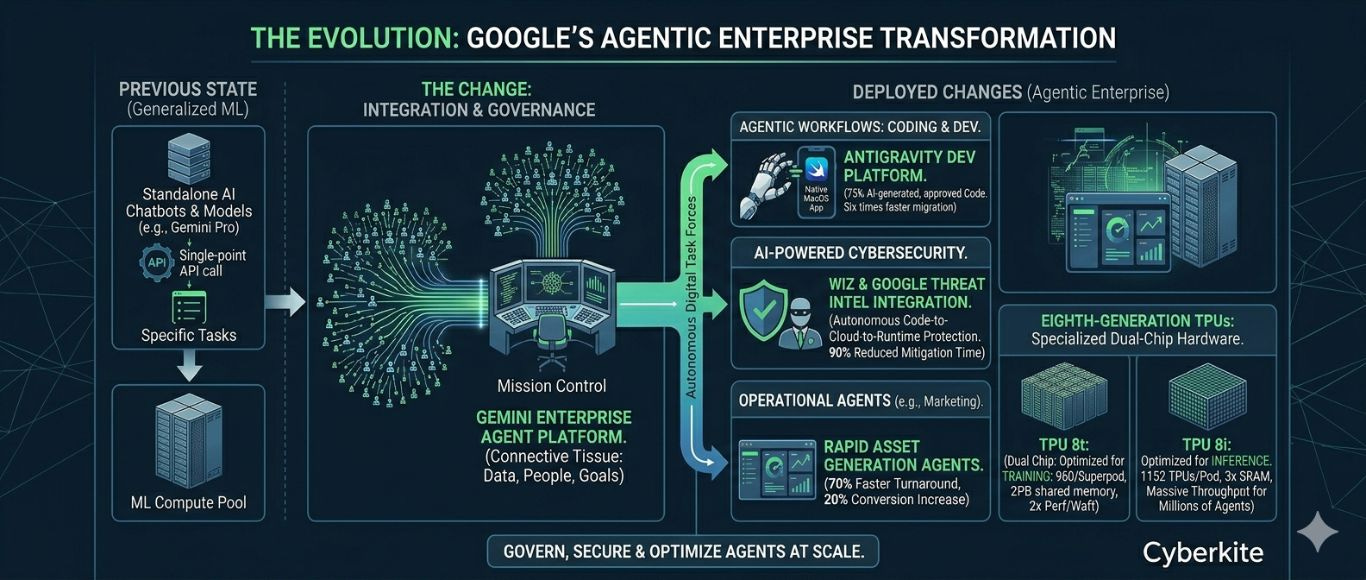
At Google Cloud Next 2026, CEO Sundar Pichai outlined a roadmap that proves AI has moved from a "copilot" to an autonomous "digital task force."
Is mind-blowing for Enterprise AI because we're now going into groups of Agents. Apparently according to Anthropic a year ago we are about a year away from fully fledged digital employees. Unfortunately they have not delivered but maybe Google is about to head towards that direction with this enterprise AI agents platform. I think we are a year away .
Are you prepared for this? Will your competitor beat you to it and maximize on output and increase customer engagement and increase the amount of customers? This is how serious this is for everyone in business.
At the center of this is the IT departments and governance leaders in every company. They will need to navigate through this carefully and smartly if they are to succeed. Otherwise it will be a disaster rather than a success.
Here is what IT Governance leaders need to understand about the four pillars of this new agentic era.
1. "Customer Zero": Proof is in the Code
You cannot sell the future if you don't live in it. Google revealed that 75% of all new code at the company is now AI-generated and approved by engineers (up from 50% just last fall).
Their teams are orchestrating fully autonomous digital task forces to complete complex migrations up to six times faster than humanly possible.
So this is the future. Eventually all code will be generated by AI and checked by humans with AI and verification tools.
Essentially every company will be able to have their own software generated very quickly and tested. I cannot stress the importance of proper and sufficient time for software testing before deployment. They put confidence in AI doing all the testing for you, but you should always do manual testing just in case. Especially on a live environments that will affect many customers and staff.
2. Governing the Swarm: Mission Control for Agents
The conversation in the boardroom has shifted from “Can we build an agent?” to “How do we manage thousands of them?”
Deploying autonomous agents accessing proprietary data requires absolute oversight. To solve this, Google launched the Gemini Enterprise Agent Platform. This is the required connective tissue for enterprise IT, a centralized hub to build, scale, govern, and optimize agents with confidence.
The flavor is in the pudding as it were so how enterprises and companies start using platform and others that will compete. I think Microsoft is doing something as well, is the real question here.
I think Google is best placed to be able to provide a full stack for Agentic ic platform that will provide hundreds if not thousands of agents depending on your budget. And hopefully they'll make it affordable and not require the need for standalone PCS like OpenClaw and NemoClaw. In a visit corporate environment, this is the way to go and the massive AI operated cyber security that they've provided of course.
3. AI-Powered Cybersecurity: Wiz Integration
Autonomous agents radically expand an organization's attack surface. To counter this, Google is fighting fire with fire. By combining Google’s Threat Intelligence with Wiz’s AI Application Protection Platform (AI-APP), they are providing autonomous protection from code to cloud.
Internally, Google's own security agents are already automatically triaging threat reports, reducing mitigation time by an astonishing 90%.
In my opinion this is great but you should never remove the human out of the picture. So Google will need to provide human involvement in this platform. But I think machine and human in defending an Enterprise is the way to go.
4. Hardware Reality: 8th-Gen TPUs
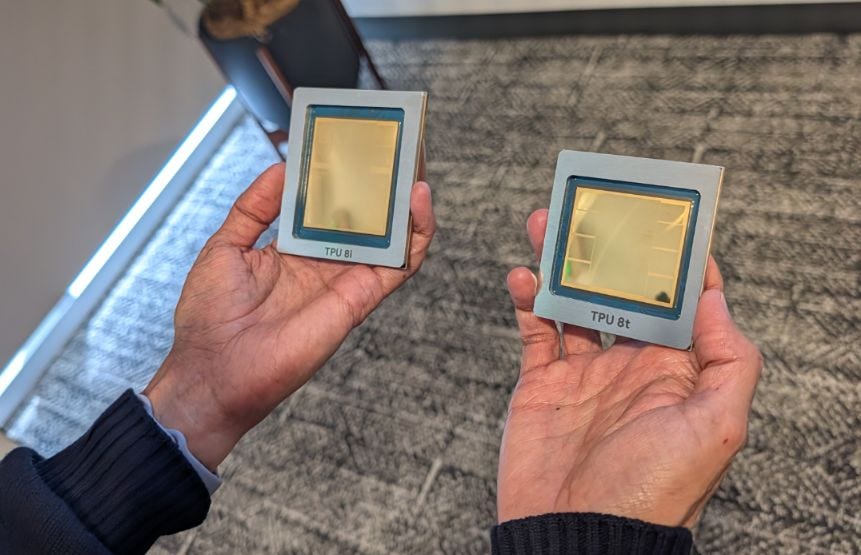
You cannot run an autonomous enterprise on legacy infrastructure. Google introduced its 8th-generation Tensor Processing Units (TPUs) with a highly specific dual-chip approach:
TPU 8t: Optimized purely for massive foundational training.
TPU 8i: Optimized for low-latency inference to run millions of agents concurrently and cost-effectively.
Recently Groq and NVIDIA The contract for the Groq inference chip design and manufacturing. This is Google responding to that with their experience now. So many years in designing TPUs.
The exciting part is the TPU 8i which will have low latency inference to run lots of AI and Agents for low-cost hopefully help Google get back to energy efficiency and environmental policies. So the price of running AI should come down in general for Google which will allow them to provide these services long-term in my opinion. Competitors will definitely be trying to get their hands on inference chips from Google or from others.
The Bottom Line for IT Governance
The transition to the Agentic Era is not a future roadmap item; it is happening right now. If your security architecture and governance frameworks are not being built to manage an autonomous digital workforce, you are accumulating massive technical debt.
Is your enterprise architecture prepared to securely govern a digital workforce of thousands of AI agents?
Will you be testing these new agentic workflows, or letting early adopters find the security bugs first?
[Subscribe to Cyberkite for weekly insights on IT Governance and Post-Quantum Readiness]
Read Sundar Pichai’s full announcement here.
Happy agentic computing
Michael Plis
References
The Official Blueprint: Sundar Pichai’s breakdown of the Gemini Agent Platform & new TPUs: https://blog.google/innovation-and-ai/infrastructure-and-cloud/google-cloud/cloud-next-2026-sundar-pichai/
The Strategic Shift: The Next Web's analysis on moving to autonomous task execution: https://thenextweb.com/news/google-cloud-next-pichai-agentic-era-scale
📺 Keynote Video: The official keynote for Google Next 26:
Google Blog: Our eighth generation TPUs: two chips for the agentic era - https://blog.google/innovation-and-ai/infrastructure-and-cloud/google-cloud/eighth-generation-tpu-agentic-era/
What are your thoughts about this? Are you ready in your business to activate agents? Is there more to it?