

For the last three years, Artificial Intelligence has been the ultimate economic cheat code. If a CEO mentioned "Generative AI" on an earnings call, their stock went up. It was viewed purely as an engine for limitless growth, a magical tool that would make everyone faster, smarter, and more profitable.
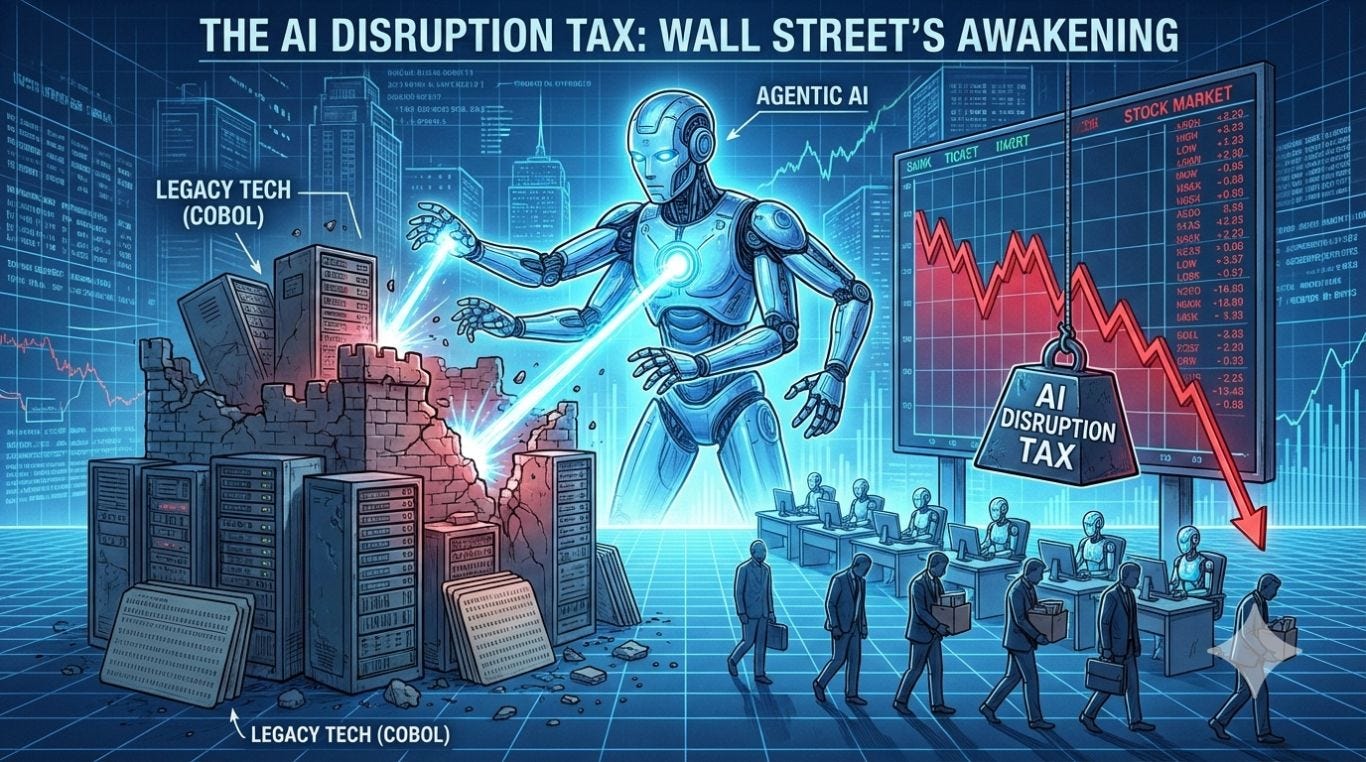
Then, this week, the illusion shattered.
The Dow plunged 800 points, and the software sector lost over $200 Billion in market capitalization almost overnight. The catalyst wasn't a change in interest rates or a bad jobs report. It was a 7,000-word thought experiment by Citrini Research titled "The 2028 Global Intelligence Crisis", a viral paper that forced the financial world to confront a terrifying question:
What if AI is so good for corporate efficiency that it actually breaks the economy?
We have officially entered a new phase of the technological revolution. We are shifting from AI that "chats" to Agentic AI that "works." And as we are about to find out, the consequences of that shift are going to rewrite the social contract.
Paradox of Hyper-Efficiency
The core thesis of the viral "Doomsday AI" report is simple, realistic, and entirely devoid of science-fiction tropes like rogue terminators. The threat isn't that AI will turn evil; the threat is that it will do exactly what we built it to do, but far too quickly.
Right now, companies are racing to integrate Agentic AI, systems capable of autonomous reasoning, navigating file systems, and executing multi-step workflows. The immediate micro-economic result is fantastic: profit margins soar because companies can achieve the same output with 30% fewer white-collar workers.
But macro-economics is a closed loop.
When every Fortune 500 company simultaneously replaces mid-level knowledge workers with AI agents to cut costs, they are collectively firing their own consumer base. If the white-collar middle class is hollowed out, who buys the software subscriptions, the cars, the mortgages, and the consumer goods?
This is the "AI Disruption Tax." Wall Street panicked this week because they suddenly realized that the hyper-efficiency of AI might trigger a massive deflationary spiral, destroying the revenue models of the very tech companies building the infrastructure.
The End of the "Safe" Tech Job
If you thought your specific niche of knowledge work was immune to this, this week provided a sobering reality check.
Simultaneous with the viral report, Anthropic released a new AI capability specifically designed to write, translate, and modernize legacy COBOL code.
To the average person, that sounds like technical jargon. To the enterprise tech world, it was an earthquake. COBOL is a decades-old programming language that still runs the backends of major global banks and governments. Because it's so old, human engineers who know COBOL are rare, highly sought after, and incredibly expensive. Legacy giants like IBM have built massive, stable revenue streams simply by maintaining this ancient code. It was considered the ultimate "safe, boring, highly-paid" tech moat.
In a single afternoon, AI automated it. IBM’s stock subsequently suffered its worst single-day drop since the year 2000.
The message is clear: There is no longer a "safe" harbor in pure logic or data processing. If a job relies solely on sitting at a keyboard, analyzing information, and producing digital output, an AI agent will soon do it faster and cheaper.
What the Future Holds: Pivot to "Wisdom Work"
So, where does this leave us as we look toward the 2030s? If the "Doomsday" scenario is a possibility, how does society adapt?
1. The Rise of the "Human Premium"
As digital output becomes infinite and practically free, it will lose its value. In a world where AI can generate a flawless 50-page strategic analysis in three seconds, the analysis itself becomes a commodity.
What will command a premium is trust, relationship, and lived human experience. We will see a shift from "Knowledge Work" to "Wisdom Work." People won't pay for the data; they will pay for a trusted human to tell them how to feel about the data.
2. A Radical Restructuring of the Tech Economy
The software-as-a-service (SaaS) model is in grave danger. Why pay $100,000 a year for 50 specialized software subscriptions when your company’s internal AI agent can just custom-code the exact tools you need on the fly? Tech companies will have to pivot from selling "tools" to selling "outcomes," fundamentally changing how Silicon Valley operates.
3. The Inevitable Policy Reckoning
We can no longer ignore the conversation around systemic economic safety nets. If Agentic AI permanently displaces 20% of the white-collar workforce over the next five years, traditional unemployment systems will collapse. Conversations around Universal Basic Income (UBI), robot taxes, or "human-in-the-loop" mandates will move from fringe academic debates to the center stage of global politics.
The Inflection Point
The market crash this week wasn't a glitch; it was a wake-up call. We spent the last three years marveling at the parlor tricks of generative text and image models. We are now entering the era of applied intelligence.
AI is the most powerful tool humanity has ever created. But this week proved that we are severely underestimating the shockwaves it will send through the very foundation of how we work, earn, and live.
I want to hear from you in the comments:
Do you think the market's fear of the "AI Disruption Tax" is justified, or is this just another technological panic that will eventually create more jobs than it destroys?
How is your specific industry preparing for Agentic AI?
Let’s discuss below.
Happy computing
Michael Plis
References
CITRINI: THE 2028 GLOBAL INTELLIGENCE CRISIS: https://www.citriniresearch.com/p/2028gic
The Viral Doomsday Report Fallout (Entrepreneur): Detailed coverage on how the Citrini Research hypothetical scenario caused a massive sell-off in names like Datadog, CrowdStrike, and Amex: https://www.entrepreneur.com/news-and-trends/the-dow-dropped-800-points-was-a-viral-ai-report-to-blame/502954
IBM’s Historic 13% Plunge & The Anthropic Threat (AI Dispatch/Jobright intel): Analysis of how Anthropic's new COBOL automation tool triggered IBM's worst single-day drop in 25 years: https://hipther.com/latest-news/2026/02/25/107637/ai-dispatch-daily-trends-and-innovations-february-25-2026-anthropic-openai-ibm-gemini-3-1-pro-hes-fintech/
The Broader Market Contagion (Reuters): Tracking the FTSE and US Stock Futures as tariff uncertainty and AI disruption fears dominate the morning bids: https://thetruestory.news/en/world/story/ec46e589-11af-11f1-bdec-a8a1590471b5
"Doomsday AI" Origin Story: The Guardian: ‘A feedback loop with no brake’: how an AI doomsday report shook US markets: A fantastic breakdown of the original Citrini Research report ("The 2028 Global Intelligence Crisis") authored by James Van Geelen and Alap Shah. It details how their hypothetical scenario of AI agents removing all economic "friction" would effectively destroy the margins of middlemen like travel agencies, SaaS platforms, and traditional payment providers: https://www.theguardian.com/technology/2026/feb/24/feedback-loop-no-brake-how-ai-doomsday-report-rattled-markets
The Deflationary Spiral & The SaaS Threat: Quartz: How an AI doomsday Substack post caused a mini market crash: This piece dives deep into the macroeconomic theory behind the crash. It explores the concept of the "human intelligence displacement spiral"—a scenario where AI drives down white-collar wages and causes mass layoffs, which in turn destroys consumer spending and creates a negative feedback loop. It explicitly highlights why the U.S. "white-collar services economy" is so uniquely vulnerable to Agentic AI: https://qz.com/doomsday-substack-post-rattles-markets
The Fall of the COBOL Empire: CIO: Anthropic's claim that AI can quickly refactor COBOL rattles IBM investors: A must-read for enterprise tech professionals. This article explains exactly how Anthropic's new "Claude Code" agent is automating the highly complex, consultant-heavy process of mapping and modernizing decades-old COBOL infrastructure. It provides the crucial context for why this specific AI release triggered a historic 13% single-day drop in IBM's stock, wiping out roughly $40 billion in market value: https://www.cio.com/article/4137185/anthropics-claim-that-ai-can-quickly-refactor-cobol-rattles-ibm-investors.html
The Hardware Reality Check: Tom's Hardware: Anthropic's new AI tool can write 67-year-old COBOL code...A more technical look at the legacy code dilemma. It explains why COBOL has survived this long (handling fixed-point decimal math for 95% of global ATM transactions) and why reverse-engineering it was previously considered too expensive for humans to bother with—until AI Agentic coders arrived: https://www.tomshardware.com/tech-industry/big-tech/ibm-stock-takes-a-13-percent-whiplash-after-anthropic-announces-an-ai-tool-for-writing-cobol-code-stock-has-worst-day-since-2000-and-is-down-25-percent-mom-and-counting