

The prevailing narrative in the tech community is that Apple is executing a brilliant maneuver: refusing to fight in the messy, expensive LLM arms race, and instead owning the "dashboard" while outsourcing the AI "engine" to third parties.
Some even compare AI to electricity, arguing that Apple doesn't need to own the power plant to turn on the lights.
This perspective fundamentally misunderstands both the nature of artificial intelligence and the historic foundation of Apple’s success. Apple isn't playing 4D chess; they have had their head in the sand like an emu, and they are about to accumulate a massive amount of Integration Debt.
The Vehicle vs. Engine Dilemma
The "vehicle vs. engine" analogy perfectly illustrates the current landscape. We are witnessing hardware giants build the "chassis" (the UI, UX, and physical device) while dropping in a third-party "engine" (the LLM).
History in the automotive industry shows this is a double-edged sword. While Aston Martin successfully utilized Mercedes-AMG engines to remain competitive, other brands faced massive brand dilution and technical friction when the engine didn't seamlessly communicate with the chassis.
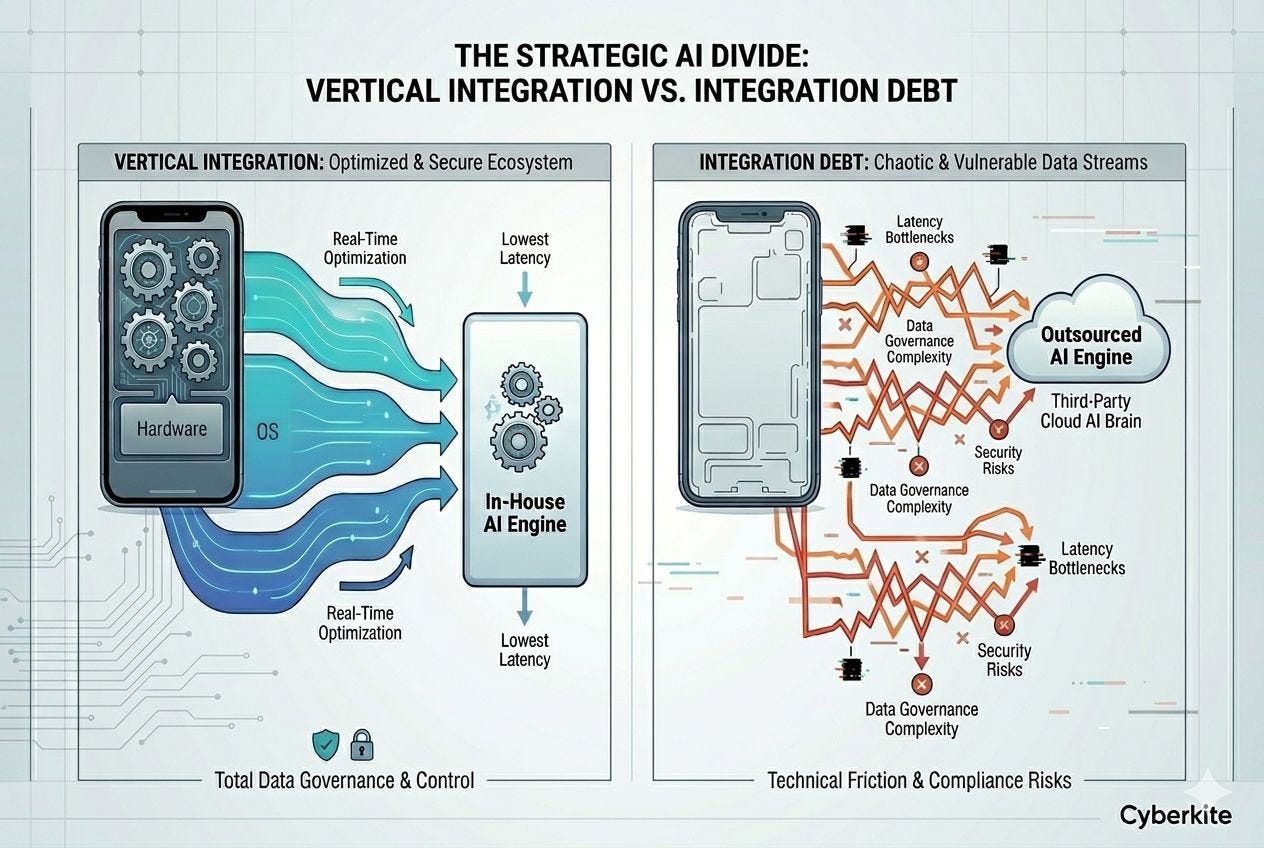
For tech companies, this friction is called integration debt. Apple’s historical "secret sauce" has always been total vertical integration, designing the silicon, the hardware, and the software to work flawlessly together. If you do not own the AI engine, you lose the ability to deeply integrate those layers.
But this doesn't just relate to the motor vehicles which are very complex. If you look at computers, for example, they have always benefited with being fully integrated with software and hardware like Apple others have followed in their footsteps such as Microsoft Surface devices and Google Pixels etc. I remember my days building desktops and stitching together different branded components. There was always something wrong with them. That simple principle applies in AI integration in my opinion.
I'm also a supporter of interoperability and universality as well, but that is not in contrary with the idea of Greater integration. For example, Linux operating system has been modified before in order to work better with particular hardware or particular applications. In the same way, AI models can be made Universal, not for specific use and then run in-house tailored to the particular manufacturer of hardware. A great example of that is Android operating system which is based on Linux and particularly well integrated in Google pixel phones.
AI is Not Electricity; It is the Brain
Sam Altman, the CEO of OpenAI, envisions a future where artificial intelligence becomes a basic utility, functioning much like electricity or water. Speaking at the BlackRock Infrastructure Summit in March 2026, he outlined a shift from AI as a software product to AI as "intelligence on demand".
The electricity analogy though falls flat because electricity is a blind, commoditized utility. AI is the intelligence, routing, and data-processing layer of the future already here now.
In the past, Apple's greatest market differentiator has always been absolute user privacy and a strict, closed-loop ecosystem. If they outsource their core AI capabilities to external providers like Google or OpenAI, they introduce massive complexities around data governance. They immediately lose their iron grip on the user data pipeline.
But there is also a trend here that we need to highlight, which is that traditional computer operating system manufacturers such as Microsoft and Apple are struggling to develop AI of their own because they have stagnated engineering departments and programmers that have no clue about this emerging technology called artificial intelligence. I think Google is better placed because they were part of the design of the transformers in Ai and the early research and they continue to have really good researchers I think.
I think Apple has not been very good at the research aspect of things and they're a bit too skittish and wait too long. I think the superpower that Steve Jobs developed was that Apple took a technology such as the idea of touch screens and handheld devices and pushed the envelope beyond its capabilities and made it affordable enough to buy. Unfortunately, Apple has not been doing that over the last few years with overly expensive devices such as the vision pros and all that. I think if Steve Jobs was around he would get the best team ever in-house to develop cutting Edge AI for Apple users across all the devices and he would tailor the experience across the board. But I think Apple just like Microsoft is struggling to build teams that can do that. They are in fact Junior partners and perhaps the AI industry is disrupting the desktop operatings system industry and even mobile device operating system industry. And that's why I think Google is well placed. If they're brave enough to proceed because they have full integration. They have the experience and they have been a disruptor in the past and they can be as well with caution towards their existing user base.
Thus, Apple doesn't need to buy a literal power company, but they absolutely must own the brain of their devices to keep their security and privacy promises intact.
The Emu in the Room
Apple ignored the generative AI wave for too long. While they saved billions by letting other companies fund the initial R&D bloodbath, building a proprietary AI engine from the ground up is more accessible now than ever, especially with Apple's vast capital and engineering draw. Be the problem. They don't have enough in-house AI developers and a proper studio to start off with. Facebook or otherwise known as Meta is in that predicament. At the moment they are a junior partner trying to catch up with the rest. We will see how meta deals with it.
By refusing to build in-house expertise and outsourcing the core intelligence of their devices, Apple is selling itself short. The real risk is that we are moving toward a world of "white-label" smart devices, where the only differentiator is the badge on the hood.
I think if Steve Jobs was alive he would be so upset as to where the direction of Apple has gone without sourcing things to others rather than making it in-house the best. And such a momentous technology as AI and the iterations that will come in the future that are even better shouldn't be left to external parties when it comes to Apple. It served them well to have everything in-house. It puts people at ease. But now outsourcing it to Google or somewhere else is going to cause a lot of people to lose trust in Apple.
And to all my Apple users that read my articles and are my customers. I can assure you that Apple is still a good brand and worth using their devices, but I guess each business needs to consider. In the coming decade, what devices speed up their output and improve the quality of their staff work and how well, such devices integrate with AI to maximize on productivity for your business. The reality is this most businesses should be starting to use AI as an assistant along with human workers. If they're not, they will fall behind with output.
So the core of the issue is this:
If Apple wants to secure the next decade of computing, it cannot afford to rent its brain.
If Apple doesn't own its engine, are they destined for the exact same integration nightmare? Share your thoughts below.
Happy Computing
Michael Plis
The cold fusion take on this:
References
References driving this strategy conversation:
"AI as Electricity": Sam Altman argues AI is a utility "like electricity or water" bought on a meter. But electricity is blind; AI processes intimate user data: https://openai.com/index/our-principles/
Apple’s "Primary Technology" Doctrine: Outsourcing AI violates the exact rule Tim Cook laid out in 2009: "We need to own and control the primary technologies behind the products that we make”: https://discussions.apple.com/thread/251301665
Automotive "Integration Debt": Legacy automakers building "Software-Defined Vehicles" are currently facing massive delays trying to marry hardware chassis with third-party software stacks. The industry literally calls this "integration debt.": https://www.researchandmarkets.com/reports/6176272/digital-twins-in-automotive-market-report