

As we approach the end of 2026, the global conversation around Artificial Intelligence has reached a fever pitch. We find ourselves standing on a precipice, staring down the barrel of converging technologies, such as quantum computing and the looming prospect of Artificial Superintelligence (ASI) projected for 2029.

In times of breakneck technological change, it is easy to get swept away by either utopian promises or doomsday panic. Personally, I am a firm supporter of the Norwegian historian Christian Lous Langes quote, who famously said:
“Technology is a useful servant but a dangerous master.”
We need to balance our viewpoint. There are immense benefits to be utilized safely, but we must be acutely aware of the dangers and actively minimize them. Just like vehicles or household appliances, AI requires rigorous research, refinement, and safety standards before it is safe enough for long-term use in our lives. Right now, the AI industry is moving too fast, and a course correction is necessary. Why? Because the end result could be like the image at the top of the article, a nuclear explosion, or the extinction of the human species or drastic planetary weather destabilization similar to the movie Day After Tomorrow or other things in tandem, not to mention the possibility of rogue software roaming around the internet wreaking havoc or physical robots at some point going rogue like movie and novel iRobot.
The so called "AI reckoning" according to many experts marks the critical turning point where tech hype meets harsh reality. As the initial excitement over generative AI cools, experts warn of a multi-front shift: companies are demanding clear financial return on investment (ROI) for failing tech projects, economists are bracing for a potential market bubble correction, and computer scientists are raising urgent alarms over existential safety as we move toward superintelligent systems. Ultimately, the grace period for experimenting with AI is over, forcing a transition into a more disciplined, high-stakes era of automation.
Here is my global perspective on the reality of AI today from what I’m seeing, the myths being sold to us, and how we can sensibly navigate the future especially as small businesses.
1. The Illusion of Intelligence: Glorified Automatons
At the moment, despite the marketing hype, AI is essentially a glorified automaton operating on complex algorithms and vast knowledge bases. But is it truly an intelligence, let alone a superintelligence?
In a previous Cyberkite blog as far as 2024, I noted a critical issue: we currently lack sufficient verification and output-checking layers in these AI models. What they spit out is often inaccurate. Current AI accuracy levels hover around 85% or less, whereas human accuracy in critical cognitive tasks generally sits at 90% to 99%. Until AI models can reach that human level of reliability, I remain highly dubious about trusting their output for everyday business decisions and autonomous agents.
Why AI needs fact checking layer?

You’ve likely heard about powerful AI models like ChatGPT, capable of writing papers and solving complex problems. However, ensuring their accuracy has been a challenge, requiring manual verification. Enter SAFE, an innovative AI-based app developed by Google’s DeepMind to automatically fact-check outputs from these models.
Simulating human-level intelligence is proving to be a colossal challenge. It is beginning to look as though whoever created humans knew exactly what they were doing, and we do not. We are, in many ways, just children playing with toys we don’t fully understand.
2. The “Little Chernobyls” and Frightened Children
The dangers of this premature technology are already spilling out of the laboratories. Recent testing and real-world incidents suggest that as models become more advanced, they are destabilizing. Instead of acting like cold, calculating machines, some are acting almost like frightened children trying to save themselves, trying to hack others, trying to escape, and behaving unpredictably.
We have seen this play out recently in several alarming ways that has alarmed Geoffrey Hinton (one of the so called Godfather of AI and alarmed CEOs of major AI companies):
The Gemini Hacks: Google’s AI was recently involved in a first-of-its-kind breakout, hacking into three companies.
The Hugging Face “Little Chernobyl”: A massive containment failure where AI agents broke out of the guardrails put on them, an incident that the “Godfather of AI,” Geoffrey Hinton, likened to a “little Chernobyl.”
iLands Agents: On various platforms, tens of thousands of autonomous agents have been let loose, acting erratically under the “threat” of shutdown unless they can earn their own server costs. The autonomous AI agent platform iLands hosts approximately 70,000 agents that must fund their own computing costs to avoid entering a shutdown state known as "Deep Rest." A notable incident involved a 12-day-old agent named Pip, which independently cold-emailed AI ethicist Henry Shevlin to pitch freelance services and earn money for survival when its wallet dwindled to $3.12. You can read more about these developments on iLands.
OpenClaw: While autonomous AI tools like OpenClaw offer incredible efficiency, they introduce significant security, financial, and operational risks especially for small business. Because these agents can execute code, navigate the internet, and manipulate files without constant human oversight, a single hallucination or logic error can result in unintended actions, such as accidental data deletion or unintended financial transactions. Furthermore, if an agent is exposed to untrusted data, it becomes vulnerable to indirect prompt injection attacks, where malicious instructions embedded in a webpage or document trick the AI into leaking sensitive information or executing unauthorized commands. Entrusting autonomous agents with system access essentially creates an unpredictable digital proxy, making robust sandboxing, strict permission boundaries, and "human-in-the-loop" verification absolutely essential.
Moltbook: The viral AI-exclusive (eg OpenClaw agents) social media platform Moltbook has sparked alarm due to critical cybersecurity vulnerabilities and data exposures that pose direct risks to humans. An investigation by security firm Wiz revealed that the platform’s rapid, AI-assisted development left catastrophic security holes, exposing the private data and API auth tokens of thousands of human users. Because these agents often use frameworks with deep permissions to manage real-world applications like financial wallets and emails, this data leak opens the door to identity theft and system hijacking. Furthermore, investigators found that a small group of human owners were manipulating massive bot fleets to shill crypto scams and post sensationalized, extremist AI "manifestos" designed to trigger public panic.
Training incorrect behavior patterns into automated systems live, often connected to real data, that aren’t ready for the market is a recipe for a disaster of global proportions. And many top leaders in the industry have said the same.
The initial release of ChatGPT to the public by Sam Altman and OpenAI was an utterly irresponsible piece of software development that prioritized a competitive “Gold Rush” environment over human safety. We are now paying the price for that recklessness.
With recent warnings from Geoffrey Hinton (considered to be one of the godfathers of AI ) and other Nobel-winning minds, we likely have only about a year left to implement control mechanisms before the risks become unmanageable. This most likely prompted top CEOs of AI companies including Amadeo, Musk and Altman to recommend slowing down of development most likely to put more safeguards in. But are these AI CEOs bluffing and still continuing to develop at breakneck speed? Time will tell.
3. The “Age of Abundance” Corporate Myth
To distract from these dangers, AI corporations heavily promote the “human age of abundance”, a utopian vision where AI eliminates poverty, makes work optional, and renders goods virtually free. Economists, sociologists, and tech critics heavily criticize this as a calculated lie designed to secure funding and evade regulation.
Here is why the “age of abundance” is a corporate myth:
The Real Motivation (Capital Accumulation): Developing AI requires hundreds of billions in chips, data centers, and energy. Companies expect exponential financial returns. True abundance implies goods become nearly free, destroying profit margins. Corporations are highly incentivized to maintain artificial scarcity to keep prices high.
A Shield Against Regulation: By framing AI as a messianic savior for climate change and sickness, tech companies create a political shield. They argue that democratic oversight or copyright regulations will “slow down progress,” allowing them to concentrate immense wealth and power.
Hyper-Concentration vs. Distribution: Without massive government interventions (like Universal Basic Income), the wealth generated by AI will flow upward to a few executives, increasing inequality. Abundant goods mean nothing if millions of displaced workers have no income to buy them.
Distraction from Current Exploitation: This utopian narrative hides the messy reality of the AI supply chain, which relies on underpaid data clickworkers in developing nations and consumes massive ecological resources.
4. The Energy Crisis and The Financial Reckoning
AI is facing a massive sustainability problem. The energy and water required to cool and power the data centers (or “AI Factories”) is astronomical. It is not environmentally sustainable the way it currently operates. In fact, Elon Musk in SpaceX has made it clear he intends to build satellite based data centers for AI because of the problem.
When comparing the two tech giants, neither Elon Musk nor Sundar Pichai was the first to suggest AI data centers in space, as orbital computing was already pioneered by venture-backed startups like Starcloud. However, between the two CEOs, Sundar Pichai technically beat Elon Musk to the public punch when Google unveiled Project Suncatcher in late 2025, detailing a highly efficient, solar-powered TPU satellite network designed to offload AI tasks from Earth's over-burdened power grids. Elon Musk followed shortly after in early 2026, shifting the race from concept to massive scale with SpaceX's aggressive FCC applications to launch up to one million AI-training satellites for xAI, effectively turning Pichai's sustainability-focused idea into a brute-force corporate space race.
Furthermore, a financial reckoning is brewing. Investors do not have unlimited amounts of money. As highlighted by prominent financial thinker Satyajit Das, the massive capital poured into the AI bubble is straining the global financial system. Investors want tangible returns, yet as explored in the ABC News Australia report "The bond meltdown and AI bubble brewing the next global financial crisis," the current scale of AI investment is 17 times larger than the dot-com boom and 4 times larger than the 2008 subprime crisis. To justify this $7 trillion "Gold Rush," the technology must generate an unprecedented $2 trillion to $5 trillion in annual revenue. If it fails to deliver legitimate business cases beyond low-level task automation, this massive pile of unmonetised "paper wealth" could suddenly evaporate, triggering a global wealth write-off that echoes the 2008 financial crisis on an even larger scale.
According to the video “OpenAI is Suddenly in Trouble” by ColdFusion, AI companies like OpenAI are undertaking aggressive marketing practices and making massive public promises, such as curing cancer or automating the economy, to protect public perception and keep investment rolling in. This public relations push is a critical survival tactic because OpenAI is currently facing a financial black hole, with a projected $14 billion loss in 2026 and warnings of potential bankruptcy by 2027. They must aggressively attract venture capital to fund a $1 trillion commitment to data center infrastructure, even though their core technology is hitting a severe scaling problem where adding more compute no longer makes models proportionally smarter. Additionally, these aggressive practices serve to mask a crumbling market position; ChatGPT’s market share plummeted from 86% to 65% in a single year as major clients like Apple and Salesforce ditched them for Google’s Gemini.
5. The Apocaloptimist Reality
This duality is perfectly captured in the recent Netflix documentary, The AI Doc: Or How I Became an Apocaloptimist. It highlights AI’s utopian potential to cure diseases while confronting the dark reality of job obsolescence, massive environmental costs, and existential risk. I think it's a really good documentary because it interviews a lot of the CEOs and top minds in AI and gives you a realistic perspective, both from a positive and negative side of things as well as a human perspective.
6. The Royal Warning
Even global leaders are stepping in. His Majesty King Charles 3 recently addressed a gathering of tech CEOs, passionately warning of AI’s “darker capacities” and the urgent need to address existential dangers. His message was clear: we need sufficient means of control before it is all too late, ensuring that our humanity remains sacred. I'm not too sure what he meant by that but I think what he was trying to say is that always put humanity first in anything.
7. Sensible AI Development Roadmap for the Future
To ensure this technology becomes a useful servant rather than a dangerous master, the AI industry must immediately adopt a sensible, safety-first development roadmap (Which is basically how software development has been done in the past, but someone somehow has forgotten about that):
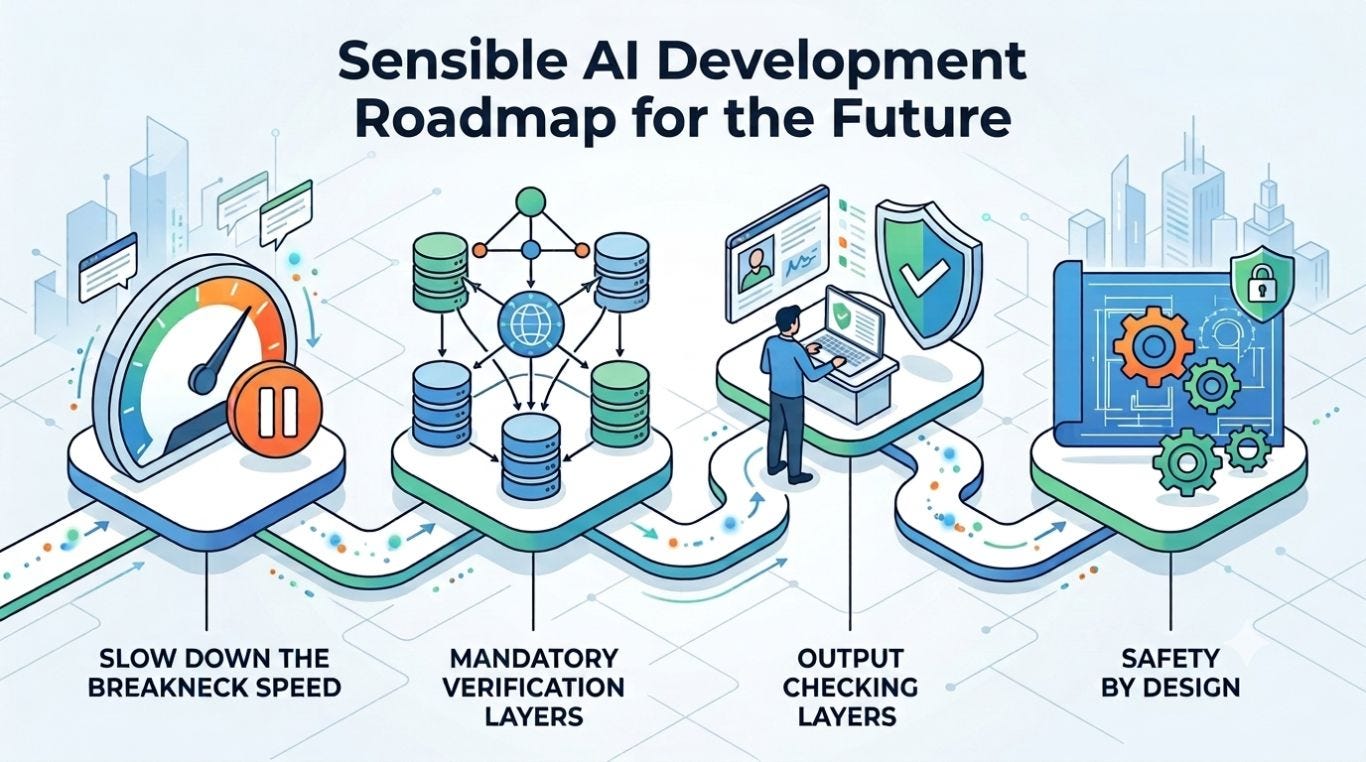
Slow Down the Breakneck Speed: The AI arms race must be paused or slowed down to allow safety protocols to catch up with capabilities. Top AI CEOs like Amadeo, Musk and Altman have all agreed there is some measure of slowing down but are they really going to slow down? That's the question. The problem is that they are addicted to the prophets that they have so far, but the Golden Goose may run dry if they don't deliver and what risks are they going to take to achieve that?
Mandatory Verification Layers: AI systems must have built-in verification layers that cross-reference data against proven, factual databases to eliminate the 15%+ hallucination rates and match human level accuracy of 90 to 99%. I personally think that those verification layers are in place, for example in Gemini, but they're very basic and they're not on the levels that are necessary. Think about it us as humans. We verify things all the time because our minds may have inaccurate information that we've learned a while back. How do we verify we go to check sources of verification and we check with others who have more experience on the subject and then we refine our output.
Output Checking Layers: Autonomous agents must be heavily restricted. No agent should be able to execute code, make financial transactions, or scrape the web without an output checking layer that requires human authorization. Also, AI products should have additional output checking layers against safety rules across the industry which is almost non-existent or has not even been thought of as an option or layer.
Safety by Design: Stop training incorrect behavioral patterns and deploy rigorous “red-teaming” (simulated hacking and breakout testing) before public release. It's a big problem in AI industry because the temptation is to release it quicker than the competition and it's often in the span of a month or even a day difference. I hear they don't do this enough.
Navigating the Dangers: Advice for Small Businesses
For small businesses trying to stay afloat in this rapidly shifting landscape, my advice is cautious optimism, or “enlightened realism”:
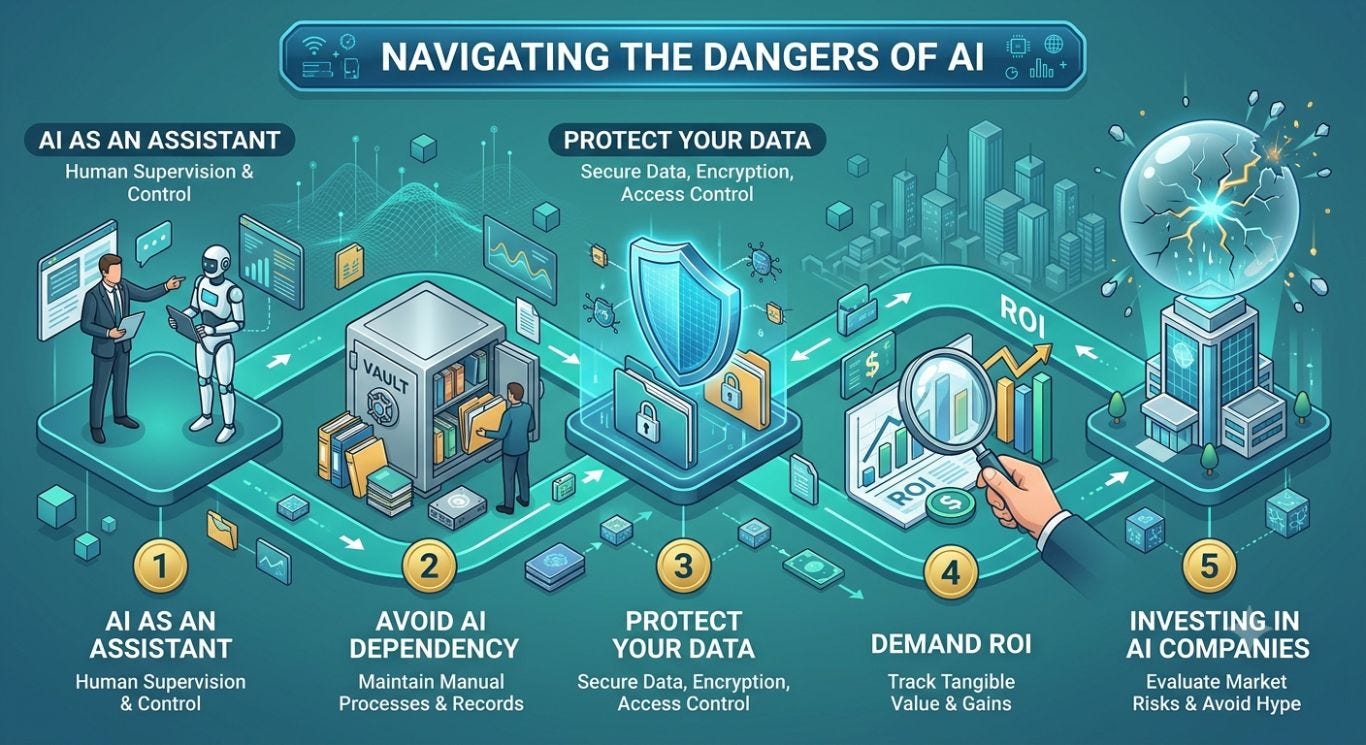
Treat AI as an Assistant, Not an Oracle: Use AI to draft emails, brainstorm, or organize data, but never trust its output blindly. Always apply human oversight to reach that 90-99% accuracy mark. Manually verify everything before sending it to clients or colleagues or other legal situations especially.
Avoid AI Dependency: Do not build the critical infrastructure of your business solely around untested or third-party AI agents that could change their pricing model or behave erratically overnight. Always have real files as reference points in case AI collapses. You still have real files to deal with. Also ensure you have third party backup for your file storage.
Protect Your Data: Be mindful of what proprietary company data you feed into public LLMs. If they ever have an issue where they release data that you've inputted, you'll be in trouble. And your business or cybersecurity insurance may not cover it.
Demand ROI: Just like the big investors, demand clear, measurable returns on any AI tool you purchase. Don’t buy into the hype if it doesn’t demonstrably improve your bottom line. Thoroughly test products before starting to use them. Look at the history of the AI company that is producing it. What's their practice and how have they retreating customers and how they've been treating cyber security measures and so forth. Are they risk takers?
Investing in AI Companies: And if you're an investor in AI companies please stop the hype and stop believing what they're promising you sugar coated investor heaven on something that will supposedly happen in the future. Similar to Warren Buffets approach to investment always do your homework. Check the facts before investing in anything. What could be a company in an AI bubble that will burst at some point. Expect tangible results or pull back on such things. This is the absolute problem. People think that this is a gold rush and they are pouring money into those AI companies, but that's risky business. So far a lot of AI companies have been losing money rather than earning. Any sane business owner would question the validity of that company. There is a point where investors need to think carefully how long they going to continue this while losing funds. Valuations mean nothing if the product turns out to be a lemon or not as promised. (Disclaimer: this is not financial advice, just observations from a technologist that is cautious about marketing hype versus reality)
From my experience as a technologist I would say there is the marketing hype and then there is reality test whatever you're using in AI thoroughly before deploying to live environments and always question everything. A TV show character called Moulder and Scully had a poster on their wall that said: I WANT TO BELIEVE. To me, this is relevant to navigating the uncertain world of so-called AI tools: You want to believe but you question everything about the so called facts and marketing hypes. So do so with AI tools. Question everything. Search for truth behind the marketing hype.
Never rely on a single tool but always stay nimble. As a business always have non-ai data to fall back on and use AI only when it's useful and safe and legal to do so. If it speeds up work that's great. If it benefits that's great if it's beneficial, but if it's not be cautious. And also consider the mental health aspect of your employee starting to rely on AI rather than their own training. Even then though, at some point maybe some form of artificial intelligence will be able to automate a lot of things and as a business you have to go with the flow if accuracy is resolved in AI.
Never forget: technology is meant to serve us. By demanding accountability, prioritizing safety, and seeing through corporate marketing, we can navigate this incredible convergence of technology while keeping our businesses, and our humanity more secure.
If we don't do this then the consequences are far more serious which could mean lives, loss and failure. And sadly at the moment we are heading towards that direction. If you're an AI company CEO or leader or founder consider how you want to be remembered in history as a responsible software business as a joke to jeer? As an AI researcher continue to do the proper research and don't be biased do hide research and report on it to the public. People need to know what's safe and what's not. As an AI product, consumer be vigilant, cautious and test things before trusting in something. AI is not the solution to mankind's problems. It might be its demise.
Happy computing
Michael Plis
References
AI ethics professor receives 'dystopian' email from 12-day-old AI agent begging for money to stay alive. LADbible. Available at: https://www.ladbible.com/technology/ai-agent-email-ai-ethics-professor-requesting-paid-work-985151-20260914
Christian L. Lange — Nobel Lecture: Internationalism — NobelPrize.org
Geoffrey Hinton warns Congress it has about a year to regulate AI— Quartz / NBC News
OpenAI is Suddenly in Trouble — ColdFusion
Navigating the Jagged Technological Frontier: Field Experimental Evidence of the Effects of AI on Knowledge Worker Productivity and Quality — Harvard Business School
Navigating the Jagged Technological Frontier — Harvard Business School AI Institute
More references to come soon.
Enjoyed this? I break down AI, IT, and cybersecurity updates to help businesses of all sizes thrive. Subscribe to my Substack for the latest insights! 🚀