

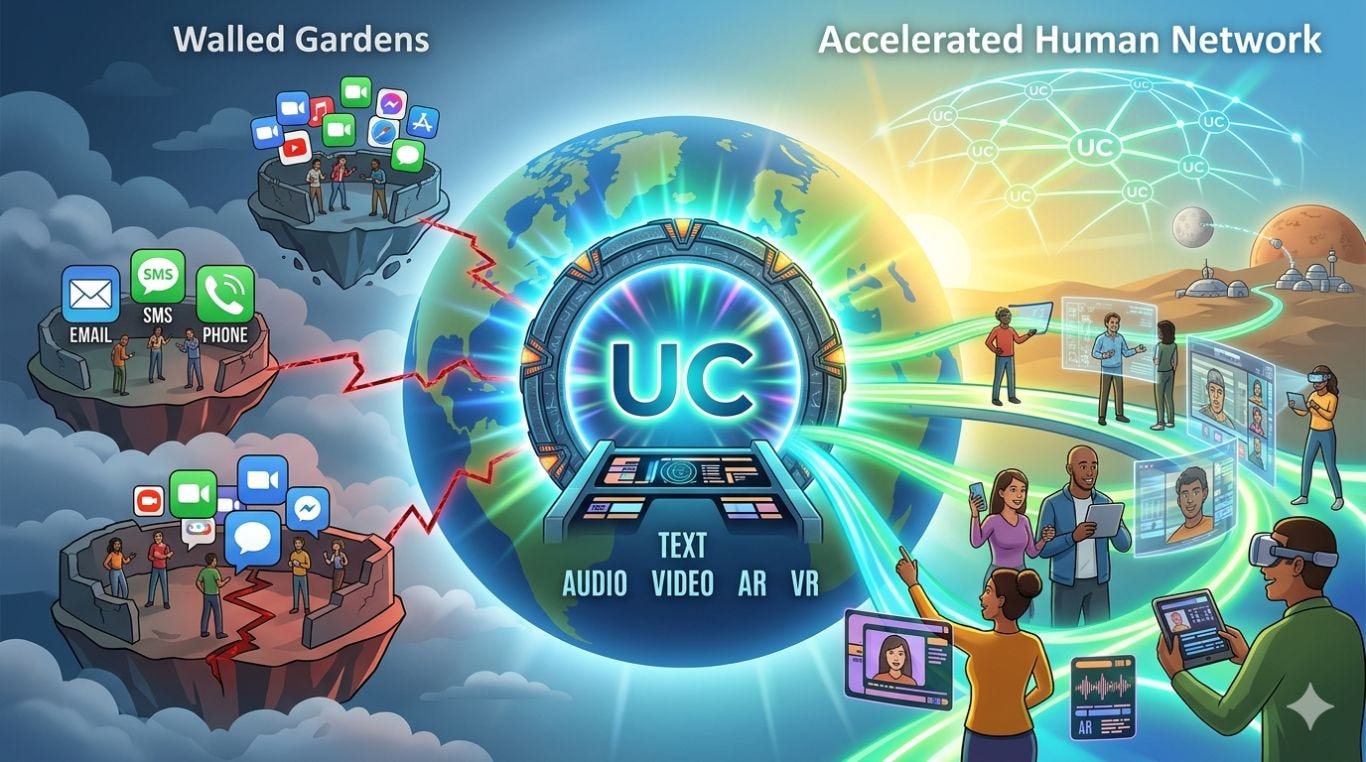
A few years ago, I wrote an article titled "Why Universal Video Conferencing & Chat Protocols are Crucial for Future of Communication". In it, I explored the concept of Universal Unified Communication (UUC) and the need to break down the silos between different enterprise teams and communication platforms.
In a way we could even simplify the analogy or the acronym to Universal Communication (UC new acronym we could embrace) which would be basically a new acronym for communications technology that allows for Universal interoperability across different apps for both video conferencing and live chat, text, audio and long form text. Effectively it would render phone, text and email redundant if it was interoperable across all apps.
Today in 2026, while we are seeing small steps forward, like the adoption of RCS messaging to bridge the gap between different phone operating systems, we are still stuck in "walled gardens." Major video conferencing and chat apps still refuse to talk to each other. If we are ever going to decommission old technology like email for something better, we need to look at how advanced communication is handled in our favorite science fiction shows and maybe learn some lessons to work on (hint, hint).
Downside of our Current “Walled Gardens” in Comms
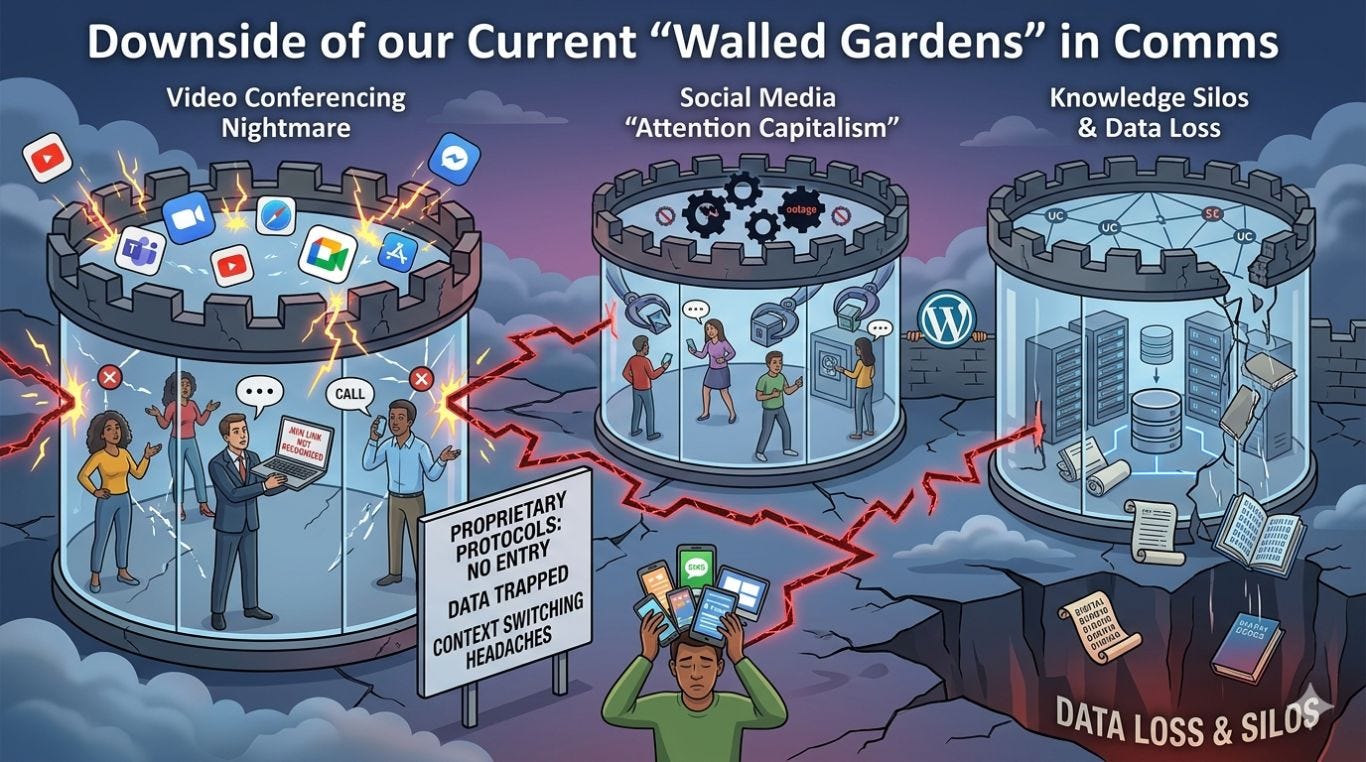
Currently, each major platform uses its own unique protocol, making it incredibly difficult for users to connect and collaborate across different communication technology platforms. This provincial and protectionist attitude from major tech companies remains the biggest hurdle to advancing human communication and knowledge exchange.
If we look at the current tech environment, the cracks in these walled gardens are causing massive headaches for businesses:
The Forced Interoperability Mess: Governments are finally stepping in because the industry wouldn't fix itself. With the EU’s Digital Markets Act (DMA) taking full effect in 2025 and 2026, "gatekeepers" like Meta and Apple are being legally forced to make messaging apps interoperable. However, because these companies didn't collaborate on a proactive, universal protocol from the start, this forced integration is clunky, delayed, and plagued by security and privacy concerns regarding how encrypted data is handled between rival apps.
The Video Conferencing Nightmare: We are in an era where businesses demand "Bring Your Own Meeting" (BYOM) flexibility, yet video conferencing remains a battlefield of unique, proprietary protocols. If for example a Zoom user wants to seamlessly interact with a Microsoft Teams, Facebook Messenger, or Google Meet or FaceTime or WebEx or any other video conferencing user, they hit a wall. Instead of innovating to make meetings hardware-agnostic, vendors waste resources competing for subscribers.
Social Media "Attention Capitalism": Traditional social networks have operated as the ultimate walled gardens, designed to trap users and hoard data. However, the rapidly growing "Fediverse" (using the open ActivityPub protocol in 2026) is proving that an alternative works. Platforms like WordPress and Ghost are adopting it, allowing users on entirely different networks to communicate seamlessly. This proves that users want interoperability, but major corporate video and chat apps are lagging behind this open-web movement.
Knowledge Silos & Data Loss: When information is trapped within these specific, closed apps, we create self-enclosed networks. If a platform shuts down, changes its pricing, or a user loses access, that knowledge is lost, much like the ancient Library of Alexandria burning down without a backup site.
To truly advance, a global communication system (with text, audio and video) it must be universal and easily useable by anyone on the planet and beyond as we start to have permanent presence on Moon and beyond.
Benefits of a Universally Connectable World
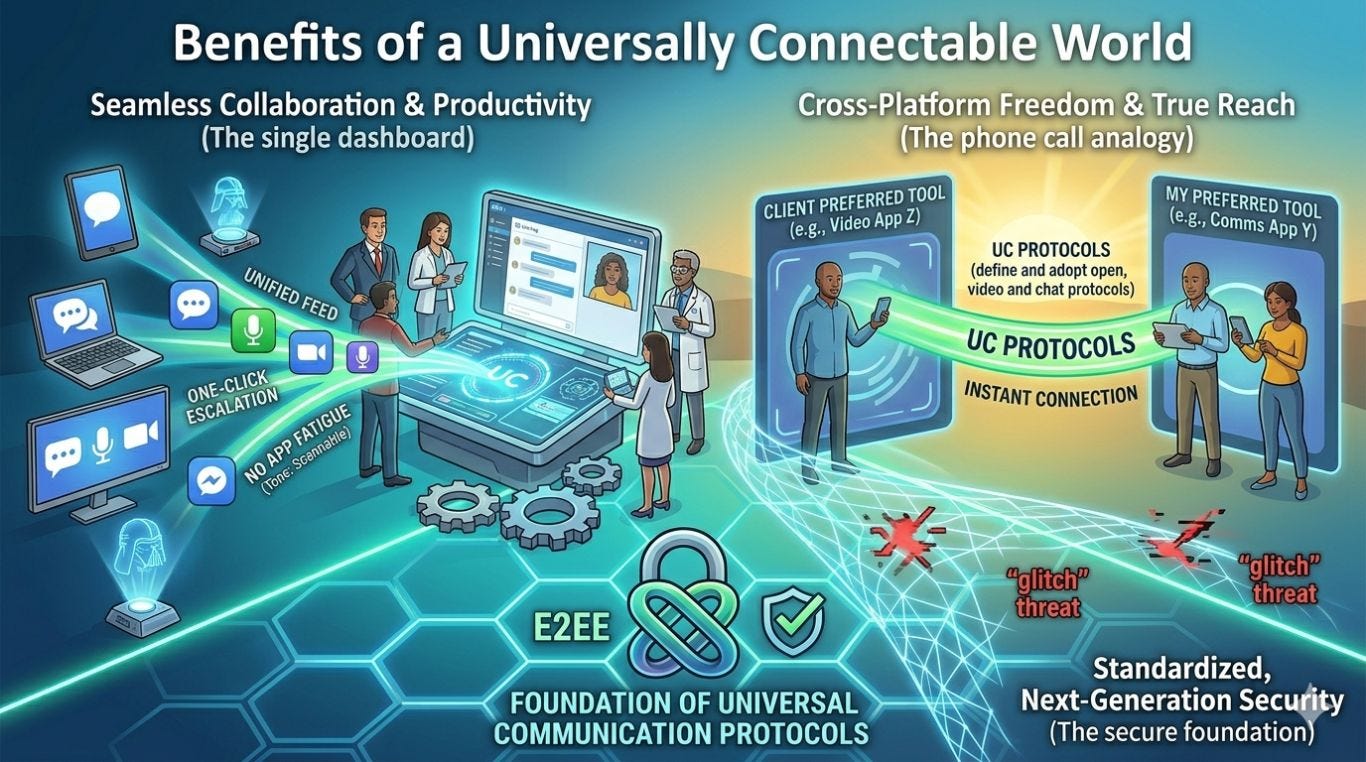
While recent regulatory pushes, like the EU’s Digital Markets Act forcing basic chat interoperability and Apple finally adopting RCS, are steps in the right direction, they are reactive patches. True Universal Unified Communication (UUC) or lets call it Universal Communication (New UC acronym) would proactively solve the app fatigue and disjointed workflows plaguing modern businesses.
If companies came together to define and adopt open, universal video and chat protocols, the benefits for global productivity would be massive:
Seamless Collaboration & Eliminating "App Fatigue": Right now, users are overwhelmed by the sheer number of communication channels they must monitor. How many chat and meeting apps do you have on your phone or your computer? Common now, tell me the truth…dozens isn't it? A universal protocol would allow a user to initiate a conversation via text chat on one platform (like WhatsApp) and instantly escalate it to a video conference with a user on a completely different platform (like Microsoft Teams). This removes the friction of forcing clients to download specific software or create new accounts just to communicate.
True Cross-Platform Freedom: You could use your preferred tool to call a client who is using their preferred tool. Just as you can dial any phone number in the world regardless of whether the person uses Telstra or Optus or Vodafone or T Mobile or AT&T or whatever else. You should be able to launch a Google Meet call directly into a client’s Zoom or Webex instance for example. This preserves customer loyalty to their favorite interfaces while enabling total global reach and huge time saved in not needing to relearn new apps. People could focus on doing business and interacting with each other rather than spending long periods of time working out how to connect to each other.
Reclaiming Productivity from "Context Switching": Modern hybrid work is heavily damaged by "context switching", the cognitive load required to constantly jump between Slack, Teams, email, and texts. Universal protocols would allow all messages and calls to funnel into the user's single preferred app when we are talking about productivity platforms as well, similar to communication apps and video conferencing apps. Not necessarily in business, but at least it would allow multiple companies to interact with each other a lot better if they didn't have to set up just to interact the other businesses app, for example, often someone creates a Slack project and then shares it with another business that they're servicing and this business has to create once off Slack account just to work with them once off. Why can't they just connect Slack with Microsoft Teams or something or Google workspace with Slack or things like that or all 3 connect to the same project to work with with the leader of the project setting the controls? This idea would allow teams to communicate faster and choose the most appropriate mode for each situation, drastically reducing communication errors and lost time. Imagine saved collaboration time and productivity between businesses for that!
Standardized, Next-Generation Security: In an era of AI-generated deepfakes and sophisticated cyber threats, fragmented security is a liability. Currently, if one app has a vulnerability, its users are exposed. A unified protocol allows the industry to establish standardized, high-caliber security measures, such as universal end-to-end encryption (E2EE) and zero-trust verification, built directly into the foundation of the communication layer. This ensures that sensitive business data and personal privacy are universally protected, rather than relying on the varying security budgets of individual app developers.
So you can see the benefits of pursuing Universal communication in live chat and video conferencing space to bring it towards Universal interoperability is a really good direction that should be pursued by everyone just as they did with email, SMS and phone calls. Basically with email, SMS and phone calls. You can contact everyone on the planet pretty much. Imagine if you could do that with live chat and with video conferencing and not needing to change the vessel or the app that provides that service. Just as with email, SMS and phone. You use whatever app that is capable of doing it. What do you think? Is this possible from an engineering and programming standpoint? Especially now that there is vibe, coding and programming is becoming easier?
Universal Communication lessons from Sci-fi

When we look to science fiction to imagine the future of technology, one common thread unites almost every vision of an advanced civilization: seamless, frictionless communication.
Writers and creators instinctively understand that a truly advanced society would not tolerate fragmented, proprietary communication networks. Instead, they depict futures where humanity, and entirely alien species together, have overcome the petty hurdles of brand loyalty and walled gardens to build universal communication infrastructures. Here is what three iconic sci-fi franchises can teach us about the path we need to take today.
UC Lessons from Star Trek
In Star Trek TV series and movies especially The Next Generation, we see a highly advanced, unified approach to communication, which has inspired many of my ideas on this topic. The Starfleet LCARS (Library Computer Access & Retrieval System) database and communication network likely utilized interplanetary, agreed-upon protocols. Whether Captain Picard was sending a text-based log, an audio transmission, or engaging in a live video conference with another ship, the system was universally interoperable.
When the Enterprise hails a Romulan Warbird or a Klingon vessel, the call connects instantly to the main viewscreen. The crew doesn't have to worry about whether the Romulans are using a different video app, or if they need to download a specific plugin first; the underlying protocols just work. It demonstrates that as a society matures, standardizing the network becomes more important than protecting a specific software brand. We need to build the foundation for our own LCARS today, standardizing how our video and chat data is packaged and transmitted.
UC Lessons from Stargate
In Stargate SG-1 TV series, highly advanced races like the Ancients, the Nox, and the Tollans didn't rely on fragmented, competing technologies. Their communication networks, and the Stargate network itself, were built on universal, instantaneous connections shared across vast alliances. The Stargate is the ultimate universal protocol: a standardized interface that allows completely different worlds, with completely different levels of local technology, to instantly connect and transfer matter and data.
Furthermore, these advanced races utilized subspace communications that could interface with almost any device. The lesson here is that a truly advanced civilization prioritizes the frictionless sharing of knowledge and collaboration over corporate competition. They view communication as a fundamental infrastructure, much like physics itself, rather than a product to be locked inside a corporate ecosystem.
UC Lessons from Star Wars
Star Wars showcases the HoloNet, a galaxy-wide communication grid that functions as a hyper-advanced, real-time internet. Whether someone was using a cheap handheld comlink on a desert planet, a highly secure encrypted console on a star cruiser, or a full-room holographic projector, they could send and receive real-time audio and video across the galaxy.
The hardware didn't matter because the underlying network protocol was universal. A hologram recorded on a droid could be instantly projected by a completely different manufacturer's ship console. This is exactly what we need for modern video conferencing, a unified standard where the device and the brand do not restrict the connection. Users should be able to buy the hardware and interface they prefer, knowing it will seamlessly plug into the universal communication grid.
What Sci-Fi Teaches Us About Our Future
The overarching lesson from all three of these science fiction universes is that communication silos are a symptom of a primitive or transitioning society. As civilizations advance, they inevitably realize that the true value of technology lies in its ability to connect everyone, everywhere, without friction. If we want to reach the collaborative heights depicted in these shows, whether that means coordinating global research on Earth or eventually communicating with permanent bases on the Moon and Mars, we must tear down our current walled gardens. Establishing universal video and chat protocols is not just an IT upgrade; it is a necessary progress step for human collaboration.
History of Universal Communications
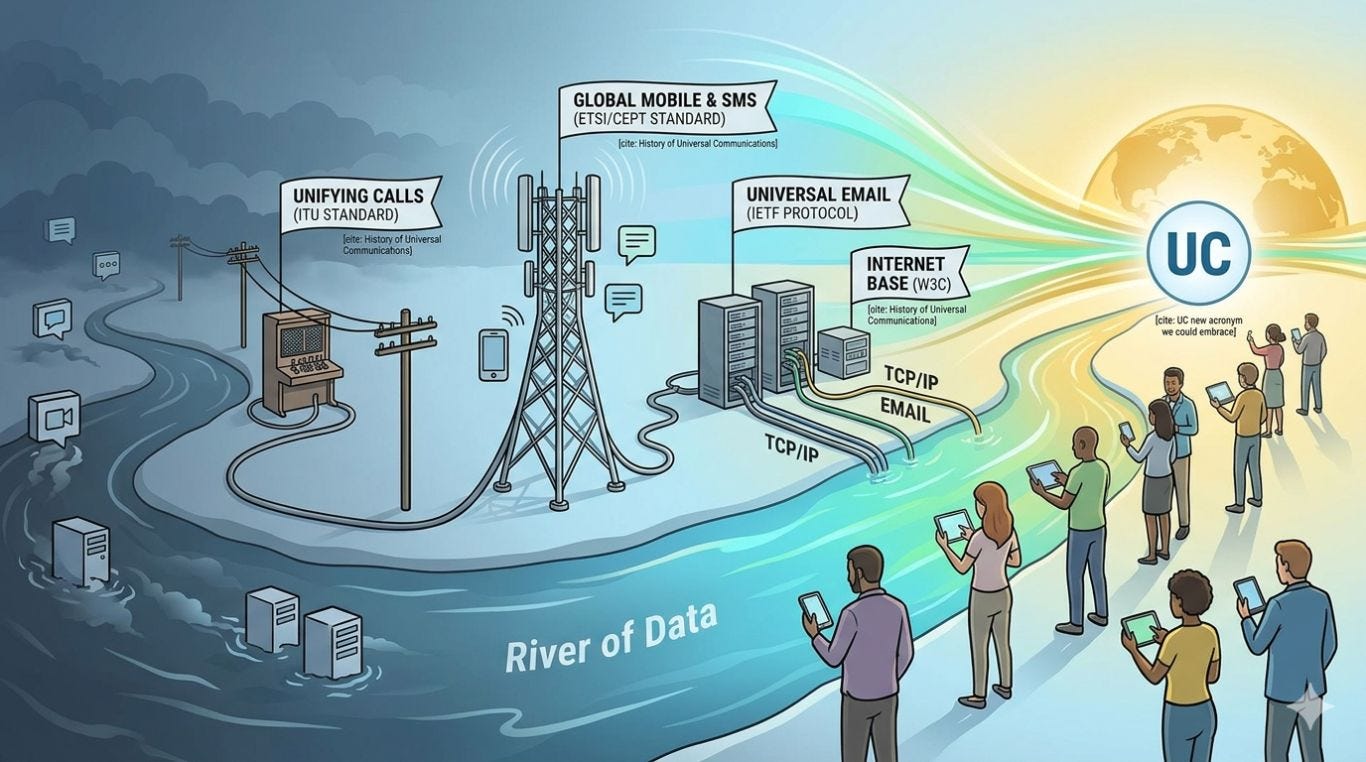
Humanity has always sought to connect and share knowledge across distances, whether through ancient letters, telegraphs, or early telephones. However, the history of unifying modern information technology and telecommunications has been a long and winding road. When we look back, a clear pattern emerges: technology only reaches its full potential when strong political will and regulatory bodies step in to establish universal standards.
The Telephone Network: The ability to call anyone in the world didn't happen by accident. It was heavily regulated by the International Telecommunication Union (ITU), a specialized agency of the United Nations. Dating all the way back to 1885 for early telephone regulations, the ITU ensured that different countries and telecom operators adopted uniform operating instructions and standard equipment so that phone calls could seamlessly cross international borders.
Text Messaging (SMS) & Mobile Networks: The ability to text between different mobile carriers was driven by immense political will in Europe. Organizations like the European Conference of Postal and Telecommunications Administrations (CEPT) and later the European Telecommunications Standards Institute (ETSI) were tasked with creating the GSM standard in the 1980s. European governments actively pushed to prevent a fragmented market of incompatible mobile phones, forcing manufacturers and network operators to collaborate on a single, pan-European digital standard that eventually took over the world.
The Internet and Email: In its early days, networks were self-enclosed and not widely used. This changed thanks to the initial funding and political backing of the U.S. Department of Defense (via DARPA), which created the early ARPANET. Eventually, oversight transitioned to global, collaborative engineering bodies like the Internet Engineering Task Force (IETF) and the World Wide Web Consortium (W3C). These groups established open, non-proprietary protocols (like TCP/IP for the web and SMTP for email) that allowed computers everywhere to share information safely, creating one unified global knowledge system.
If political willpower and international regulatory bodies could unite the global phone network, text messages, and email, they can absolutely do the same with modern video conferencing and live chat. We simply need the industry (and regulators) to prioritize global connection over closed ecosystems.
Hypothetical Future: Accelerated Human Network
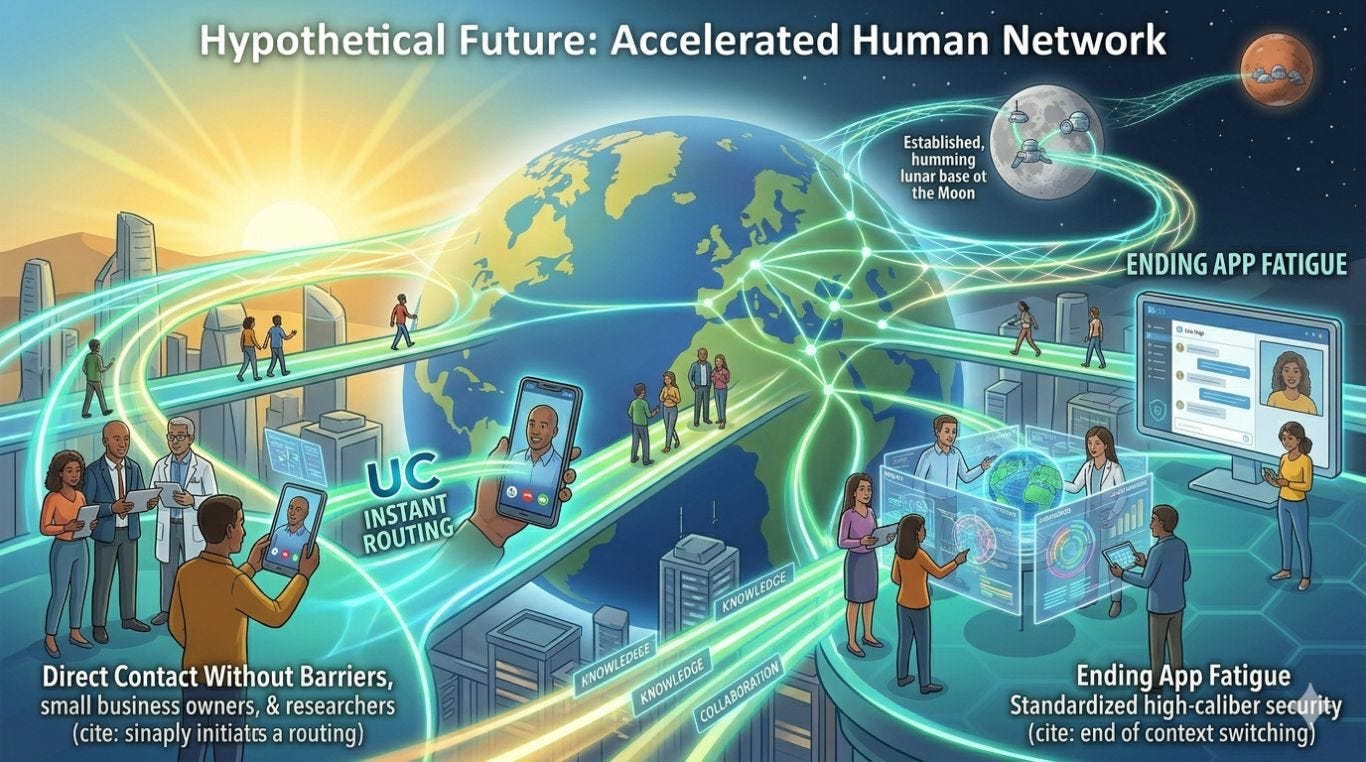
Imagine a world in the near future where the "walled gardens" have finally collapsed. You open your device, running the secure, open-source operating system of your choice, and simply click a contact's name. You don't have to stop and think about whether they use WhatsApp, Messenger, Viber, Zoom, WebEx, Google Meet, Microsoft Teams, or FaceTime on Apple device. You simply start a video call or live text chat, and the universal protocols route your connection securely and instantly across the globe to the right address. The organizer becomes host. The participants connect using the universal communication protocols. And you have synergy of global communication in place.
Post-Social Media Era: Restoring Human Contact
This universal interoperability is becoming urgently necessary today. Traditional social media is rapidly declining in popularity as people realize the dangers of algorithm-driven communication technologies that prioritize viral outrage over mental health. Artificial intelligence has almost made it unnecessary to have social media since AI becomes the assistant and the social interaction when no one else is available (which of course has its own dangers we will talk about in the future). As society retreats from these toxic public squares, we are seeing a massive shift back toward direct, authentic human-to-human or contact via private group chats and video calls.
However, if we rely on these direct communication tools while they are still trapped in corporate silos, our ability to connect remains fractured. Universal protocols will ensure that this new era of direct, simpler, human-centric communication is open to everyone, rather than being controlled by a few gatekeeper companies.
Exponential Knowledge Exchange with future UC
In this universally connectable world, global knowledge exchange accelerates exponentially. Researchers, small business owners, and creators can collaborate instantly without technical barriers. By tearing down these digital walls, we could remove the friction of corporate gatekeeping, allowing ideas to flow more freely especially in this AI and quantum age upon us. Perhaps it will help humanity to advance from infantile stage to the next level. But I highly doubt it. I don't know it's 50/50 but I do know that in the long term future. This has to happen Universal communication across all types of formats: text, audio, visual and video, AR, VR and beyond.
Imagine! Mutually assured universal communication (not mutually assured communication silos) with people using live chat or video conference app of choice as we are but it all works with all others.
So you can have chat groups made of WhatsApp, Viber, Messenger, iMessage, X Chat and RCS users. Or just live chat with anyone in the world safely tied to a phone number.
Or perhaps arrange a video meeting with people that use Zoom, Google Meet, WebEx, Ms Teams, X Chat and FaceTime? No fuss, organiser sets up and all others recieve and participate. The Organizer is the data host.
Question for Developers at Apple, Microsoft, Zoom, Google, Microsoft, WebEx, Goto, Viber, WhatsApp, Meta, X and others - question for you, is this technologically possible to setup universal live chat and video conference protocols for everyone by the industry? The internet of rich universal communications would be born much like phone, sms and email.
We can finally shed the clunky, spam-filled relics of email and traditional phone lines and danger of plain text sms. Instead, humanity could operate on a single, secure, interconnected digital fabric with industry supported universal communication protocols. By building these universal protocols now, we prepare ourselves to work efficiently not just on Earth, but eventually on permanent bases on the Moon, Mars, and beyond. Look how quickly RCS has been adopted as of 2026! What's possible for live chat apps and video conferencing apps in the future?
Happy communicating
Michael Plis
References
Cyberkite Blog 2023: Why Universal Video Conferencing & Chat Protocols are Crucial for Future of Communication by Michael Plis. URL: https://blog.cyberkite.com.au/p/why-universal-video-conferencing
News Article (Messaging Interoperability): Messaging Interoperability: WhatsApp enables third-party chats for users in Europe (Meta Newsroom). URL: https://about.fb.com/news/2025/11/messaging-interoperability-whatsapp-enables-third-party-chats-for-users-in-europe/
Legal/Academic Review (EU DMA): Digital Markets Act and the interoperability requirement: is data protection in danger? (MediaLaws). URL: https://www.medialaws.eu/digital-markets-act-and-the-interoperability-requirement-is-data-protection-in-danger/
News Article (RCS Adoption): Everything to know about Apple RCS support in 2025 (Sinch). URL: https://sinch.com/blog/apple-support-rcs/
Industry Analysis (RCS): RCS is no longer a future vision, it's happening now: the 2025 comeback of rich messaging (Digital Virgo). URL: https://www.digitalvirgo.com/blog/rcs-is-no-longer-a-future-vision-its-happening-now-the-2025-comeback-of-rich-messaging-paving-the-way-for-the-next-generation-messaging-standard-in-2026/
Technical Dispatch (Fediverse): Federated Social Media Platforms (European Data Protection Supervisor). URL: https://www.edps.europa.eu/system/files/2022-07/22-07-26_techdispatch-1-2022-federated-social-media-platforms_en.pdf
Tech Standards News (ActivityPub): Implementing Encrypted Messaging over ActivityPub (Social Web Foundation). URL: https://socialwebfoundation.org/2025/12/19/implementing-encrypted-messaging-over-activitypub/
Policy Paper (Social Media): A Public, Interoperable Social Media Space (Open Future Foundation). URL: https://openfuture.eu/policies-for-the-digital-commons/interoperable-social-media/
Peer-Reviewed Research Paper (Video Conferencing): Can Video Conferencing Be as Easy as Telephoning?—A Home Healthcare Case Study (Scientific Research Publishing). URL: https://www.scirp.org/journal/paperinformation?paperid=64370
Industry Whitepaper (Video Interop): Video Interop in the Hybrid Work Environment (Webex / Recon Research). URL: https://www.webex.com/content/dam/www/us/en/ebook/solutions/interoperability/Recon-Research-Video-Interop-in-the-Hybrid-Work-Environment_cm-4999.pdf
Protocol Analysis (Video Conferencing): The Latest Video Conferencing Standards and Protocols (Metrigy). URL: https://metrigy.com/the-latest-video-conferencing-standards-and-protocols/
Star Trek Reference (Subspace & Devices): Communicator (Star Trek) (Wikipedia) – Details the fictional communication devices, the LCARS interface, and the subspace transmission protocols that bypass normal physical limitations for instantaneous contact. URL: https://en.wikipedia.org/wiki/Communicator_(Star_Trek)
Star Trek Reference (LCARS Operating System): Library Computer Access and Retrieval System (LCARS) (Wikipedia / Memory Alpha) – Details the primary computer operating system used across Federation starships. It provides a unified graphical interface for diverse tasks, including data retrieval, log recording, and secure subspace communications, ensuring universal interoperability regardless of the specific vessel or station. URL: https://en.wikipedia.org/wiki/LCARS
Star Wars Reference (The HoloNet): HoloNet (Star Wars Universe Wiki) – Explains the galactic communications grid commissioned by the Galactic Senate, which uses hyperwave transceivers and s-threads to route hologram and data communications instantaneously across the galaxy. URL: https://starwars-universe.fandom.com/wiki/HoloNet
Stargate Reference (Subspace & Alteran Tech): Subspace communication (Vennix Productions / Stargate Wiki) – Details how different cultures (Ancients, Asgard, Goa’uld) utilize subspace communication networks and long-range terminals to transmit data across galaxies. URL: https://vennixproductions.fandom.com/wiki/Subspace_communication
Any thoughts on this article? What do you think of the idea?!